Lore:Elder Scrolls

The Elder Scrolls (Kelle in the Dragon Language[2]), also called the Aedric Prophecies (though the accuracy of that term is often disputed), are scrolls of unknown origin which simultaneously archive both past and future events.[3] The number of the Scrolls is unknown not necessarily due to their immense quantity, but because the number itself is unknowable, as the Scrolls "do not exist in countable form".[4] They are fragments of creation from outside time and space,[5] and their use in divining prophecies is but a small part of their power. They simultaneously do not exist, yet always have existed.[2]
From a philosophical viewpoint, the origin and purpose of the Elder Scrolls is rather obscure and indescribably abstract. As one author puts it, "Imagine living beneath the waves with a strong-sighted blessing of most excellent fabric. Holding the fabric over your gills, you would begin to breathe-drink its warp and weft. Though the plantmatter fibers imbue your soul, the wretched plankton would pollute the cloth until it stank to heavens of prophecy. This is one manner in which the Scrolls first came to pass, but are we the sea, or the breather, or the fabric? Or are we the breath itself? Can we flow through the Scrolls as knowledge flows through, being the water, or are we the stuck morass of sea-filth that gathers on the edge?"[6]
Any person gifted with prescient powers is able to interpret the contents of the Elder Scrolls with practice.[7] The information revealed about the future is never absolute.[8] Once an event foretold within the Scrolls is carried out in the world it becomes fixed within them. Such insight into the inner fabric of reality comes at a price as the Divines usually take away the sight of the reader.[9] As a result each new foretelling and interpretation strikes the reader with blindness for a greater period of time, while simultaneously granting them a broader view of the Scroll's contents. Ultimately, the reader, having engaged in frequent acts of prophecy, is left bereft of their vision, forever after removed of their right to read the Scrolls. By time-honored tradition, the Empire allowed only the priests of the Cult of the Ancestor Moth to read from the Scrolls, while younger members cared for the elders as they gradually and irreparably lost their sight.[10] The Ritual of the Ancestor Moth is one method of reading an Elder Scroll.[11]
Contents
History[edit]

Long ago, the Dwemer devised a means to extract knowledge from the Scrolls without requiring someone to sacrifice their sight. Complex machinery interfaces with the Scroll and draws out information, inscribing it onto a metal Lexicon which can then be read by those with the requisite knowledge.[12] It is unknown how the quality or quantity of the information gained this way compares to that when read directly from a Scroll.
Second Era[edit]
Hermaeus Mora, the Daedric Prince of Forbidden Knowledge, was known to possess a number of Elder Scrolls circa 2E 582. They can sometimes be seen floating within vats in his infinite realm of Apocrypha.[13]
Numerous Elder Scrolls were stored at the White-Gold Tower within a chamber known variously as the Imperial Library, the Hall of Records, and the Elder Library.[4][14][15] During the Three Banners War in the Second Era, the Imperial City fell to hordes of Daedra. To protect the scrolls, the Cult of the Ancestor Moth hid several of them around the grounds of the Temple of the Ancestor Moths in northeastern Cyrodiil. Eventually, troops from each alliance found the scrolls and stole them from the moth priests.[16] Across Cyrodiil, each alliance built vast holy temples to house the scrolls they had stolen. The temples were built close enough to the battlefields to bestow the scrolls' blessing onto the troops.[17][18] After the war ended, many scrolls were re-housed within the Imperial Library.
Third Era[edit]
During the Imperial Simulacrum in the late Third Era, many organizations across the provinces attempted to decipher an Elder Scroll with an artifact, usually a tablet that was key in the process. These included the Mages Guild of Winterhold[19] and Corinthe.[20] The Brotherhood of Seth used a code from an ancient map to locate the Crypt of Hearts on an Elder Scroll, so that the Eternal Champion could acquire a piece of the Staff of Chaos.[21]
Circa 3E 422,[22] Count Corvus Umbranox wished to retire from his position as leader of the Thieves Guild and return to his wife, Countess Millona Umbranox of Anvil. However, he had been cursed upon donning the Gray Cowl of Nocturnal: his previous identity had been erased from the minds of others, forcing him to assume the identity of the infamous Gray Fox.[23] This curse had been placed upon the Cowl by Nocturnal herself when it was stolen from her by the first Gray Fox, Emer Dareloth. Umbranox found himself unable to reveal his true identity to anyone, instead simply appearing to them as a stranger.[22] Undeterred, Umbranox spent the next eleven years planning a heist to steal a particular Elder Scroll from the Imperial Palace in order to break the curse. Circa 3E 433, he enlisted the aid of the Hero of Kvatch to plan and execute the heist. With the Elder Scroll in his possession, Umbranox invoked its powers to rewrite history as if Dareloth had never stolen the Cowl from Nocturnal, thereby breaking the curse.[24]
Following the Palace break-in, rumors circulated that a Scroll had been stolen by a master thief.[25] In response to these rumors, an Imperial Librarian attempted to take a complete inventory of the Scrolls, but the effort proved fruitless as their numbers and placement seemed to fluctuate for no discernible reason.[4] Around 4E 175, the Elder Scrolls mysteriously vanished from the Library, and were scattered across Tamriel.[11]
Fourth Era[edit]
Circa 4E 180, a previously undiscovered Elder Scroll was found within the statue of the founder of the town of Rivercrest, Cyrodiil.[26]
The year 4E 201 saw the discovery of three Elder Scrolls. Two Elder Scrolls were discovered in Skyrim itself, one hidden in the Dwemer city Blackreach and the other in the ancient ruin of Dimhollow Crypt. The third was located in the Soul Cairn.[27][28]
Known Elder Scrolls[edit]
- Elder Scroll (Blood)
- Elder Scroll (Celemaril Light-Bringer)
- Elder Scroll (Dragon)
- Elder Scroll (Nocturnal's Curse)
- Elder Scroll (Planemeld Obverse)
- Elder Scroll (Sun)
- Elder Scroll of Alma Ruma
- Elder Scroll of Altadoon
- Elder Scroll of Chim
- Elder Scroll of Ghartok
- Elder Scroll of Mnem
- Elder Scroll of Ni-Mohk
- Elder Scroll of Rhunen
Notes[edit]
- Arngeir of the Greybeards viewed the Elder Scrolls as "blasphemies".[29]
- Runes written on the Elder Scrolls and their covers seem to be the same kind of runes that are found on the amulets of the Elder Council, which seem to be made of a metal similar to that of the Elder Scrolls' covers and crimped with a similar purple gem.
- The names of the Elder Scrolls that were fought over during the Three Banners War (Alma Ruma, Altadoon, Chim, Ghartok, Mnem, Ni-Mohk) are all words mentioned in Mankar Camoran's Commentaries on the Mysterium Xarxes.[30]
- According to some legends, the Druids of Galen were in possession of an Elder Scroll.[31]
Gallery[edit]
-
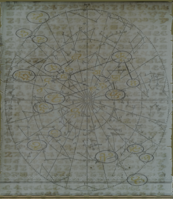
Page of an Elder Scroll (Skyrim)
-
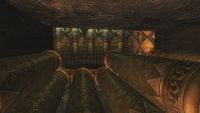
The Elder Scrolls inside the Imperial Palace, as seen in Oblivion
-
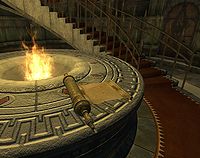
An Elder Scroll (Oblivion)
-
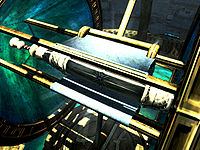
An Elder Scroll (Skyrim)
-
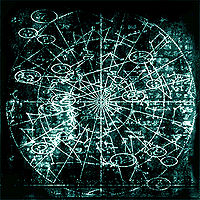
Contents of an Elder Scroll (Skyrim)
-
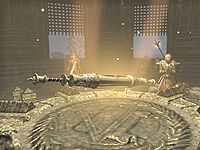
An Elder Scroll in use during the Alliance War (ESO)
-
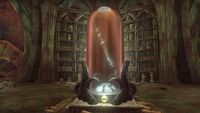
An Elder Scroll stored within a vat in Apocrypha (ESO)
-
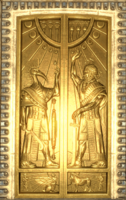
Tu'whacca to the left depicted with an Elder Scroll
-
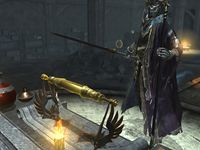
Celemaril Light-Bringer with an Elder Scroll (Blades)


.jpg)


See Also[edit]
- For game-specific information, see the Oblivion, Skyrim, Elder Scrolls Online, and Blades articles.
Books[edit]
- An Accounting of the Scrolls by Quintus Nerevelus, Former Imperial Librarian — An author's report on the Elder Scrolls and his subsequent entry into the Cult of the Ancestor Moth
- Divining the Elder Scolls — A fragment of information about the nature of the Elder Scrolls
- Effects of the Elder Scrolls by Justinius Poluhnius — A thesis on the four different types of readers of the Elder Scrolls
- Elder Scroll — The contents of one the mysterious Elder Scrolls
- Lost Histories of Tamriel — Excerpt concerning the Aedric Prophecies, otherwise known as the Elder Scrolls
- Moth Sister Terran Arminus Answers Your Questions by Moth Sister Terran Arminus — A moth sister answers questions on lore
- Pension of the Ancestor Moth — A Temple novice's initiatory pamphlet on the Cult of the Ancestor Moth
- Ruminations on the Elder Scrolls by Septimus Signus, College of Winterhold — A philosophical view on the role of the Elder Scrolls
References[edit]
- ^ The Elder Scrolls: Legends - E3 2015 Teaser Trailer
- ^ a b Paarthurnax's dialogue in Skyrim.
- ^ Lost Histories of Tamriel
- ^ a b c An Accounting of the Scrolls — Quintus Nerevelus, Former Imperial Librarian
- ^ Description in Blades
- ^ Ruminations on the Elder Scrolls — Septimus Signus, College of Winterhold
- ^ Effects of the Elder Scrolls — Justinius Poluhnius
- ^ Divining the Elder Scolls
- ^ Urag gro-Shub's dialogue in Skyrim
- ^ Pension of the Ancestor Moth
- ^ a b Dexion Evicus' dialogue in Dawnguard
- ^ Septimus Signus' dialogue in Skyrim
- ^ The Feral Gallery, The Underweave and elsewhere in Apocrypha in ESO: Necrom
- ^ The Wolf Queen, v1 — Waughin Jarth
- ^ Events of Oblivion
- ^ Sandana Axius's dialogue in ESO
- ^ Protector Arfire's dialogue in ESO
- ^ Grand Warlord Dortene, overheard at a Daggerfall Covenant camp — Grand Warlord Dortene
- ^ Thelen Kaarn's dialogue in Arena
- ^ Turamane ap' Kolthis' dialogue in Arena
- ^ Halfas Varn's dialogue in Arena
- ^ a b The Gray Fox's dialogue in Oblivion
- ^ Instructions: the Gray Cowl — Office of the Unseeing Eye
- ^ The Ultimate Heist quest in Oblivion
- ^ Palace Break-In?
- ^ Events of Blades
- ^ Events of Skyrim
- ^ Events of Dawnguard
- ^ Arngeir's dialogue in Skyrim
- ^ Mythic Dawn Commentaries — Mankar Camoran
- ^ Systres History: Volume 1 — Trilam Heladren, Associate Dean of Eltheric History, University of Gwylim
![[Content is available under Attribution-ShareAlike]](http://en.uesp.net/w/images/4/4d/Somerights.png)
