Lore:Trinimac

—Forge-Mother Alga
Trinimac, the Warrior,[1] the Paragon,[2] and the Golden Champion,[3] was a prominent god of the early Aldmer; in some places, he was even more popular than Auri-El. He was considered "Auriel's greatest knight",[4] and he was a warrior spirit of the original elven tribes that led armies against mankind, and was known as the strongest of all the et'Ada who wandered Nirn. He is often depicted holding his sword Penitent, also known as Vosh Rakh, the "Blade of Courage". Boethiah is said to have "eaten" Trinimac and assumed his shape so the Daedric Prince could convince a throng of Aldmer to listen to him, which led to the creation of the Orcs and Chimer.[5][6][7] Afterwards, popular legend holds that Trinimac vanished from the mythic stage, only to return as Malacath, nothing more than a weak and vengeful version of his former glory.[5][8]
Contents
Worship and Culture[edit]
Altmer[edit]

As Aldmeri society evolved, commoners stopped worshipping their own ancestors and began worshipping the ancestors of their social "betters", elevating them to the level of gods through collective adulation. Trinimac was one such ancestor.[9] He is often referred to as the champion of Auri-El (even the champion of the entire pantheon).[7][10][4] He's found in the pantheon of several races of elves, including that of the Snow Elves.[11] An Aldmeri creation myth says Trinimac was on the front line during the et'Ada's conflict with Lorkhan, who they believe tricked their ancestors into creating Mundus. After Lorkhan's forces drove them from Atmora and sundered Old Ehlnofey, the legend says Trinimac knocked down Lorkhan in front of his army and ripped out his Heart "with more than hands", undoing the God of Mortals. But when Trinimac and Auri-El tried to destroy the Heart, the Heart just mocked them and said, "This Heart is the heart of the world, for one was made to satisfy the other", forcing them to hide it instead.[4]
Ayleid[edit]
Although Ayleids followed the Daedra, the Aedra of the Elven pantheon were still widely revered, with probably a majority of the Ayleids continuing to pay them homage, but cults devoted to the various Daedric Princes sprang up across Cyrodiil, tolerated and then celebrated.[12]
Orc[edit]
- "Trinimac is a warrior god who stands for unity and civilization. Before Malacath was, Trinimac is! Who needs blood and fury when a true god grants us courage and lifts us on high?" — Trinimac Priest
.jpg)
Trinimac is a god of major importance among the forward thinking progressive Orcs of Wrothgar. Orcish followers of Trinimac believe the deity did not get cursed into Daedric Prince Malacath as popular belief suggests, but instead Trinimac, alongside the other Aedra, gave his essence to the creation of Nirn, and that his influence can still be felt through Nirn.[13] Trinimac is known to have been a figure of worship in Orcish households of Orsinium during the kingdoms existence in the late First Era.[14] Some Orcs venerate Trinimac as their god-ancestor rather than Malacath. Orcs of the Trinimac cult insist that Trinimac fooled Boethiah into believing he was corrupted by his passage through Boethiah, when in fact he absorbed some of Boethiah's strength and passed it on to his followers and seeing themselves as the "improved Elves."[15]
In the Second Era, King Kurog reinstated the worship of Trinimac as the official religion of the Orsimer.[16] A cult led by Kurog's mother in secret attempted to force the conversion of the Orcs to the worship of Trinimac and to abandon the worship of Malacath. Once the plot was discovered that Kurog intended to kill all the Clan chiefs as part of his plan to force the strongholds to convert to the worship of Trinimac and work with him. The plot would be foiled by The Vestige, who ended up killing Kurog before he could slay all the clan chiefs.[17]
Around 3E 399, King Gortwog gro-Nagorm of Orsinium established a new priesthood devoted to the worship of Trinimac in order to espouse the understanding that Trinimac still lived, and that Malacath is an unrelated demon seeking to trick them. A minority of traditionalists within the territory, and the majority of Orcs without, viewed this as heresy.[18] While Gortwog's city would soon collapse after the Oblivion Crisis, this belief in Trinimac would live on well after The Great War with some heretical Orcs who still believe that Malacath is a liar and has somehow imprisoned Trinimac.[19]
Orc followers of Trinimac use Ebony as a material for their armors and weapons in token of Lorkhan's blood when Trinimac tore out his heart. They believe that Zylvara, the great eagle bore the Golden Champion to his reckoning with the man-demon Quarvish.[3] One of their sacred scriptures was known as the Book of the Warrior God, sometimes also referred to as Book of Trinimac.[20][21]
Dunmer[edit]
To the Dunmer, it was Trinimac who preached that Lorkhan's idea for the mortal realm had been a trick all along and fomented war against Lorkhan and his followers, men. According to them, Trinimac believed that "tears were the best response to the Sundering", and encouraged hatred of Lorkhan for his actions.[6]
Legends[edit]

Most of the legends of Trinimac are of his transformation and defeat. As the Altmer's chief protector, he fought enemies both without and within.[7] In the Late Middle Merethic Era (or the Dawn Era; sources differ),[7][22] after the Aldmer had settled the mainland of Tamriel,[23] Trinimac and his followers became engaged in trying to halt the Velothi dissident movement.[7][24]

Legends say that Boethiah was angered by the "lies" Trinimac was spreading about Lorkhan.[6] They call Boethiah the "Devourer of Trinimac",[25] for they say the Prince tricked Trinimac, consumed him, and then assumed his form.[5] Through dreams and visions, Boethiah convinced Veloth to build a new sect dedicated to the belief that mortals could ascend to become gods. Trinimac's priests condemned this "blasphemy", and when they were about to pass judgment, "Boethiah appeared, having swallowed Trinimac, and revealed the lies of Trinimac's teachings with Trinimac's own voice." After thoroughly shaming the priests, Boethiah relieved himself of Trinimac in front of the assembly.[24]
While most legends don't record how Trinimac was defeated, Orcish legend says that when Trinimac confronted Boethiah for the Velothi trespass and tried to fight, Mephala appeared and stabbed him in the back, bringing him to his knees while a gloating Boethiah cursed and twisted him.[26] After he was defeated and consumed, it is said Boethiah tortured his spirit in her belly. The Daedra Lord eventually grew bored and instead exiled Trinimac to a plane of choking ash. This torture and dishonor left Trinimac twisted and enraged. Trinimac faded and was reborn as Malacath (also called Mauloch).[24]
According to legend, the dung Boethiah excreted became Malacath.[5] The followers of Boethiah and Trinimac rubbed this excrement on themselves to change their skins.[10] Altmeri propaganda portrayed this as a lesson on the dangers of Velothi influence,[5] while Velothi propaganda regarded Trinimac's transformation as punishment for attempting to interfere with their exodus. Malacath himself derided this tale as being too "literal-minded" (implying the essence of the story is somewhat accurate).[27]
Those who agreed with Boethiah and followed the Velothi exodus became the Chimer, and Boethiah taught them many things, such as the "Tri-Angled Truth" and the rules of Psijic Endeavor.[6] Those who maintained allegiance to Trinimac, even as their lord festered inside Boethiah and his mind became bent on revenge, "changed to match" Trinimac and became the Orcs, a people cursed to exile.[7][24][28] They became outcasts, like their new god Malacath.[7] Though Malacath is treated as a separate entity, he seemed to inherit Trinimac's enemies. He is known as one of the Four Corners of the House of Troubles to the Dunmer, descendants of the Chimer,[8] and Malacath became legendary for terrorizing the domain of men.[7] Trinimac's teachings were forbidden in the Chimer's new homeland, modern-day Morrowind.[29]
Gallery[edit]
-
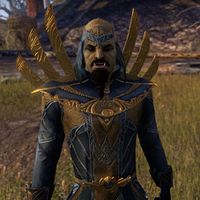
Priest of Trinimac
-
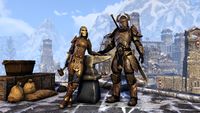
Trinimac Cult armor style
-
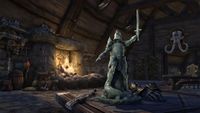
Statuette of Trinimac, Paragon
-
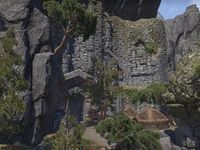
Paragon's Remembrance, a temple to Trinimac
-
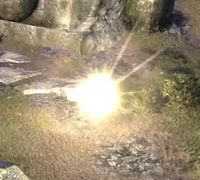
A "fragment of Trinimac" summoned by Orsimer magic


Notes[edit]
- In Sermon 8 of his Lessons, Vivec wrote that "Boethiah [...] wore the skin of Trinimac to cleanse the faults of Veloth", likely indicating that Trinimac and his followers were making it difficult for Veloth to convert people before Boethiah's intervention. Both there and in Sermon 10, Vivec made reference to the eating of Trinimac as an example of what he considered one of the particularly glorious "Walking Ways", or paths to achieving divinity.
- The Charwich-Koniinge Letters, Volume 4 mentions there's a statue depicting the "Transformation of Trinimac" in Amiglith, a town in Summerset Isle.
- Father Of The Niben suggests that the Orc creation myth may be inaccurate, as Topal the Pilot encountered creatures he called "orcs" long before Trinimac's encounter with Boethiah.
- A xenophobic and bigoted High Elf once referred to Trinimac as the "shape-taker".[30]
See Also[edit]
- The Anticipations by Anonymous — Overview of the members of and the relationship between the Tribunal and the Daedra
- The Changed Ones — Story of how Boethiah refuted Trinimac
- The Fall of Trinimac by The Faithless One — An essay on the defeat and rebirth of Trinimac
- The Scroll of Avalian — An account of Avalian's battle with a fiery beast
- The Scroll of Usunok — An account of Usunok's hunt
- The Scroll of Vaia — An account of Vaia's battle with Rhogar the Destroyer
- The True Nature of Orcs — Book detailing the Orsimer race and their origin
- Ushenat's Notes by Ushenat — The notes of an adherent of Trinimac
- Varieties of Faith... by Brother Mikhael Karkuxor of the Imperial College — An expansive list of the pantheons and associated divine spirits of Tamriel's dominant cultures
- The Warrior's Blade — A short text on the god Trinimac
References[edit]
- ^ Forge-Mother Alga's dialogue in ESO
- ^ Statuette - Trinimac, Paragon
- ^ a b Crafting Motif 22: Trinimac Style — the Venerable Uugus, Priest of Trinimac
- ^ a b c The Monomyth
- ^ a b c d e Varieties of Faith... — Brother Mikhael Karkuxor of the Imperial College
- ^ a b c d The Changed Ones
- ^ a b c d e f g h The True Nature of Orcs
- ^ a b The House of Troubles
- ^ Pocket Guide to the Empire, 3rd Edition: The Blessed Isle: Alinor and the Summersets — Imperial Geographical Society, 3E 432
- ^ a b The Anticipations — Anonymous
- ^ Gelebor's dialogue in Dawnguard.
- ^ Daedra Worship: The Ayleids — Phrastus of Elinhir
- ^ ESO Live - Episode 29, Wrothgar (56:30-57:49)
- ^ Trinimac House Idol
- ^ Varieties of Faith: The Orcs — Brother Mikhael Karkuxor of the Imperial College
- ^ High Priestess Solgra's dialogue in ESO
- ^ Events of Blood on a King's Hands in ESO
- ^ Pocket Guide to the Empire, 3rd Edition: Orsinium — Imperial Geographical Society, 3E 432
- ^ Villager Dialogue from Blades during The Heretic questline
- ^ Ordatha's dialogue in ESO
- ^ The Scroll of Avalian
- ^ Before the Ages of Man — Aicantar of Shimerene
- ^ Father Of The Niben — Florin Jaliil
- ^ a b c d The Fall of Trinimac — The Faithless One
- ^ Dialogue of Boethiah cultists in Skyrim.
- ^ Mauloch, Orc-Father — Ramurbak gro-Abamath
- ^ Lord of Souls — Greg Keyes
- ^ Pocket Guide to the Empire, 3rd Edition: All the Eras of Man, A Comprehensive History of our History — Imperial Geographical Society, 3E 432
- ^ 36 Lessons of Vivec, Sermon 1 — Vivec
- ^ Inulale's dialogue
|
|||||||||||||||||
|
|||||||||||
|
|||||||||||||||||
|
|||||||||||
![[Content is available under Attribution-ShareAlike]](http://en.uesp.net/w/images/4/4d/Somerights.png)

