
Lore:Khajiit

.jpg)
Khajiit (listen ⏵, from Ta'agra, meaning desert-dweller) are cat-like people who come from Elsweyr, known for high intelligence and agility.[1] These traits make them very good thieves and acrobats, but Khajiit are also fearsome warriors. They are rarely known to be mages.[2] Khajiit mostly stay on land, but piracy and Skooma trade does draw some to work as sailors.[3]
Khajiit anatomy differs greatly from both men and mer, not only because of their fur, tail, and sometimes toe-walking stance, but also their digestive system and metabolism.[4] Khajiit, Argonians, and Imga are the so-called "beast races" of Tamriel because of these large differences.[1] Khajiit have a lifespan similar to that of humans.[5] There are no well-documented cases of cross-breeding between Khajiit and other races, though there are rumors of such a thing.[4][6] The foreign appearance and behavior of Khajiit make them common targets of racial discrimination,[7][8] being given the name Cat-Men by foreigners,[9][10] which the Khajiit don't take lightly.[11]
History[edit]
Before the first Men or Mer set foot on Tamriel, the Khajiit were already native to the continent.[12][13] However, the origin of the cat-folk on Tamriel remains debated. Legend speaks of the Khajiit to have originated from an intelligent feline race or being their cousins.[14][15][16] This belief could be supported by the interpretation of the encounter with four- and two-legged cat demons by Topal the Pilot to be ancient Khajiit, just as Tamriel was still being explored the first time by Aldmer.[17][1]
Other theories speak of them being descendants of Aldmeri settlers, proved by the visual similarity of Ohmes and Ohmes-raht to Men and Mer, especially Bosmer.[UOL 1][18][19] The Khajiiti creation myth suggests the Bosmer and Khajiit to have common ancestors; Azurah having taken the forest people that were torn between the shape of beast and man and given them the many shapes of the Khajiit. But with Y'ffre telling Nirni of Azurah's doings and shaping the remaining forest people into the Bosmer, this link was cut.[20]
- → See the main article: History of Elsweyr
Culture[edit]
Art and Architecture[edit]

The architecture of the Khajiit venerates the divine nature of the moons.[21] The Khajiit's age-old culture is evident in their ancient stone architecture.[22] Much of these ancient structures, including some of their great monuments, have fallen into disrepair.[23] Newer Khajiit architecture has since emerged, featuring stilted houses and pointed roofs. Both new and old architectural styles are often blended together within Khajiiti cities.[22]

Some of the architectural accomplishments of the Khajiit involve taming various environments. The city of Rimmen is a great example, which functions as an artificial oasis maintained by canals and great aqueducts.[24] Other examples include rock-cut architecture, which involves many Khajiiti stone buildings built into cliff faces.[25] The Khajiit have also tamed the realm of the moon Jode, erecting Khajiiti temples there which ancient Khajiiti Moon-Priests once visited to honor the moons.[26]
Fashion: Armor, Weapons, etc.[edit]
The oppressive climate of Elsweyr makes it impractical to wear heavy clothing and armor. The typical bipedal Khajiit dresses in an ample shawl of brightly-colored cloth, known as a budi, for defense against the harsh rays of the sun. This shirt is tightly fastened in braids down the right side, to prevent any part of the torso fur from being seen, as the exposure of such in public is deemed both offensive and unsightly.[18] Khajiit martial efficiency is a priority in Khajiiti culture, and armor and weapons are built for their naturally lithe frames and dexterity. The lightest of armor is quilted or padded with cloth around the midriff and vital areas.[27] Medium-weight armor is exquisitely fashioned from loose-fitting leather, and the heaviest armor is leather overlaid with lacquered and highly-burnished metal plates. As Khajiit dislike restraint, only under the most harrowing of conditions will they don full battle armor. Khajiit are flamboyant in their fashion choices and, as a result, their light armor is often mistaken for flamboyant clothing.[27] Furthermore, most Khajiit bedeck themselves with jewelry, trinkets, and occasionally even herbs such as Nightshade.[28] Their tattoos often have a deep cultural and religious significance, as they signify their race, tribe, and the gods of their worship.[18]
The Khajiit of Anequina and Pellitine developed visually distinct styles of armor and weapons. Anequina Khajiit base their equipment off of the fashion of Darloc Brae. Although iconography of the moons is consistent within Khajiit equipment, Anequina styled armor in comparison delves heavily into lunar imagery. Every piece of Anequina styled armor typically features their image to show reverence. The Khajiit of Pellitine design their armor to intimidate, such as their helmets being shaped to look like snarling cat-demons. Regardless of region, Khajiiti weapons are designed to be lightweight, and boots and gloves are designed to have claws uncovered. To the Khajiiti people, exposed claws are necessary for dexterous hand movements and to ensure that they can never truly be disarmed.[29][30]


Claw-Dances[edit]
The art of Claw-Dances (known as the Rain-of-Sand fighting styles by the other races of Tamriel) refers to the Khajiiti martial arts, which play a major part in the race's history and philosophy. They are considered synonymous with the unarmored form of defense. There are many different disciplines that can generally be taught in the Temple of Two-Moons Dance, but they are known to be studied in their own monasteries, commonly known throughout the province of Elsweyr as the adeptoriums.
While most see Claw-Dances as a form of combat, they are meant to be a form of meditation, much different than the other races' forms of meditation, which are quiet and lack motion. The claw-dances draw upon the nervous energy that emanates from the monks, which finds expression in raw physicality. The predatorial instinct of the Khajiit and the natural range of motion of their claws give rise to this distinct form of martial art that incorporates claw-strikes and wide leaps.
Language[edit]
- Main Article: Ta'agra
Ta'agra is the language spoken by the Khajiit of Elsweyr. Although many natives of Elsweyr can speak Tamrielic, it is not uncommon for Khajiit to interject Ta'agra words or phrases into their sentences. Khajiit notably tend to have a speech pattern that consists of talking in the third person when speaking in Tamrielic.
The word "khajiit" is derived from the Ta'agra words "khaj" and "-iit", khaj meaning "sand" or "desert" and the suffix -iit indicating an occupation or place of residence. As such, khajiit might be translated as "desert-dweller" or "one who works in a desert"—but since all one commonly does in a desert is walk, khajiit is normally translated as "desert-walker", a term often used when referring to Khajiit.
Food[edit]
- Main Article: Khajiit Cuisine
Known for their love of sweets, the Khajiit enjoy a wide array of specialty dishes and desserts. Many of the meals eaten by nomadic clans are cooked over a campfire. They use moon sugar, a sweet, white powdery substance, as a spice in many of their meals. As a result, much of their cuisine is very sweet. They consume moon-sugar in one form or another every day. They use so much moon sugar in their cooking that they've developed a tolerance to amounts that would prove fatal to other races. Many people from other cultures can't stomach the sweetness, and some Khajiiti fare is dangerous for outsiders to consume.
This love of moon-sugar has given them a sweet tooth; candies, cakes, puddings, and sugar-meats are the staples of the Khajiit diet, each generously enriched with moon-sugar. This relationship between religion and cultural practice goes deeper than appearances suggest. According to legend, the Khajiit and their deities are bound by the Lunar Lattice, no less than the famed Liminal Barriers (the tendency of Mundus to remain discrete from the Sea of Oblivion and the force that keeps the Daedra out of Nirn). In this way, the Khajiit, moon-sugar, the moons, Lorkhan's Heart, and the White Gold Tower are all related, as all play a part in shaping the fundamental structure of the mortal plane.
Some nomadic clans partake in a ritual before eating with guests. The first meal is cake, which is round in shape, and laid down on a cloth at each participants' spot. The server sets each individual place at the dining area with a platter of cakes, a stack of cloths, and a pitcher of golden liquid. They set down a cloth, put a cake on the cloth, sprinkle the cake with moon-sugar, then let exactly four drops of liquid drip onto the dusted cake. This is repeated exactly for each participant. Then, everybody introduces themselves. When the last person's name is given, the Khajiit first lick their cakes, then eat them. Non-Khajiit can simply touch the cake to their mouth without eating it, as these cakes contain moon-sugar. Touching the cake to one's mouth satisfies the spirit of the ceremony. Those who eat cake with a Khajiiti clan are considered friends for the time being. They may offer strangers protection the day the cake is eaten, but the next time they meet, they have no obligation to be friendly.
Holidays[edit]
- Festival of Sugar-Singing:[31]
Hygiene and Medicine[edit]
Khajiit may use specialized filing stones to shape, file, and assist in shedding their claws.[32] In the home, a wooden dowel wrapped in hefty rope may be kept beside a vanity for the purpose of claw care.[33] Alfiq and senche in particular have been noted to groom themselves similarly to cats, using their tongues to clean their fur and paws, but typically seek privacy to do so as with any form of bathing.[34]
Entertainment[edit]
"Chewing sugar" is a thick form of moon-sugar favored by Baandari traders, who chew it. Chewing sugar is kept in specialized chawboxes.[35]
Society[edit]

The Mane, while the unofficial head-of-state, is no more a "breed" of Khajiit than any other is; they are simply unique. Khajiit tradition holds that only one Mane may be alive at any one time since the Mane is one entity reborn in different bodies with the passage of time. The veracity of this is unknown, but there has been no recorded instance of multiple Manes contending for power.[18] The Khajiit are divided by two disparate ways of life: the civilized jungles and river basins of southern Elsweyr, which have ancient mercantile traditions, a stable agrarian aristocracy based on the exportation of saltrice and Moon Sugar, and a thriving artistic culture, which contrasts greatly with the nomadic tribe or pride-centric Khajiit of the dry northern wastes and grasslands, where aggressive and territorial raiders occasionally unite under a single chieftain.[36][37] It is widely held that the greatest force among the Khajiit are the Clan Mothers. It is they, ultimately, who control both the harvest and refining of Moon Sugar, and thus they who are seen as the most influential. Over the years, Khajiit frequently have had to deal with the worry of being kidnapped and sold into slavery, especially from Morrowind.[38][39][40]

The Khajiit often refer to Moon Sugar as "crystallized moonlight", trapped by the glimmering waters of the Topal Sea and washed to the sugarcane groves of the Tenmar Forest by the tides, under the guidance of Hermorah. The Khajiit believe that by consuming it, they are consuming a small portion of the eternal souls of the moon gods, Jone and Jode. It drives them into fits of ecstasy and abandon, purportedly leaving the streets of Elsweyr's major cities strewn with catmen shivering in the grip of sugar-fits. Despite the extremely addictive nature of the sugar, it is an integral part of Khajiit life and the chief export of Elsweyr, where it is smuggled out in both its raw and refined forms.[18][41] It helps support a thriving black market; it is said one can purchase practically anything among the Khajiit. Khajiit of the desert tribes are often buried with only a small cairn of stones, so their bodies can be easily used by necromancers.[1][42]
Moon-Singers are known as keepers of the lore and storytellers of ancient tales and legends. Similar to the Bosmeri Spinners and Reachfolk Vateshrans, they are well respected among the Khajiit and are primarily found in Elsweyr. Knowledge of some ancient tales, such as the tale of Khunzar-ri and the demons, are split across several Moon-Singers in order to maintain its secrets.[43][44]
While the majority of Khajiit prefer to use their razor-sharp and retractable claws as weapons in numerous forms of Khajiiti martial arts like Goutfang, Whispering Fang and Rawlith Khaj, many have mastered the use of the sabre, scimitar, dagger, and longbow. Their chosen mastery is often reflected in male Khajiit names, through which they display their status in life with the prefix; though care is always taken, for the use of two titles is perceived as the result of either great pride or ignorance. While widely speculated, it is unknown whether the Khajiit are in any way related to the Po' Tun (currently Ka Po' Tun) cat people of Akavir or the Lilmothiit, a vulpine beast race which inhabited Black Marsh.[45][46]
Khajiiti Clans[edit]
Long before the unification of Anequina and Pellitine into one kingdom, sixteen Khajiiti clans roamed the province. These clans went to where they needed, but they are often simplified as belonging to a region or realm. With a combination of outside pressures and mastery of areas of expertise, it became more accurate to associate a clan with an area. Eventually, sixteen tribes became sixteen kingdoms. The lullaby known as the Hasa Zha'ja explains how these clans got their name, while the poem known as Zhan Zhab tells of the transition from clan names being used to refer to the names of regions. Due to the Thrassian Plague, these sixteen clans changed their tribal functions or they may have died due to starvation and other hardships. These clans essentially became two and were separated ideologically and geographically as what we would come to know as Anequina and Pellitine.[47] New clans would however emerge.
The following is a list of Khajiit clans whose names are known. Other clans exist, but have not been named and are not included in the list. For Khajiit vampire clans, see the following list here.
- The Baandari Pedlars (or simply the Baandari) are a clan of nomadic Khajiiti merchants that travel all over Tamriel, going as far as the northern regions of the Iliac Bay and the Western Reach, or the elven territories of Valenwood and the Summerset Isles. Despite the animosity they experience from the other races, they are inclusive when it comes to recruiting non-Khajiit into their ranks.[48] They live by a code of conduct known as the "Baandari Code," which states that loose items are rightfully salvageable, the peddlers must indulge clients in prophecies they want to believe in, and guarantee them of a product's utmost value and versatility. The Baandari Clan live by this lifestyle and with no other alternative as it is set in stone.[49] They considered themselves the "wandering litter" of Baan Dar, the Bandit God of southern Tamriel. They adopt the god's will, as seen in their name.[50][19]
- The Duneguard Outwalkers, formally known as the Dakarn Clan, were Khajiit brigands that waged war with the Vinedusk Rangers of Valenwood, across the provincial border in Reaper's March. They were active in the late years of the Second Empire. Remnants of this clan became known by their current name, the Duneguard Outwalkers.[51]
- F’aashe, not much is known about them but they inhabited a region of Elsweyr west of Rimmen during the Umbriel Crisis, and were a free clan barred entry from Rimmen. Due to the scarcity of moon-sugar in their region yet being plentiful in the xenophobic city of Rimmen, some among their warriors agreed to accompany Attrebus Mede to stop the flying city Umbriel as thanks for purchasing the vital product from Rimmen. They traveled through various planes of Oblivion hoping to reach Vvardenfell before Umbriel did, and the Khajiiti warriors that accompanied Mede perished within the Hunting Grounds to allow Attrebus to escape from Hircine's pursuit.[3]
- Ne Quin-al (or Ne Quin'al) were a clan of warriors trained in martial disciplines and battle tactics, and are the origin of the name of the geographical region of Anequina. After the merging of the sixteen original clans of Elsweyr into two clans, the Ne Quin-al were separated geographically from the Pa'alatiin and would make their home in the arid northern region of what is now called Anequina. They would continue to roam and follow tribal customs.[47]
- Pa'alatiin were a clan of Moon-Priests that lived among all clans, and origin of the name of the geographical region of Pellitine. They left an imprint within Southern Elsweyr in the city of Senchal when they provided aid amidst the Thrassian Plague, where social systems were changing. After the merging of the sixteen original clans of Elsweyr into two clans, the Pa'alatiin were separated geographically from the Ne Quin-al and would make their home in the southern region which is now called Pellitine, and would become greatly influenced by external forces. Indeed, they emulated much of their customs from other lands, forming political and social structures that primarily resembled those of High Rock and Cyrodiil. [47][52]
- The Pride of Alkosh are a clan of warriors founded by Ja'darri, the first champion of Alkosh. Cubs born under the eclipse who are not destined to rule as the Mane are given to this clan, becoming known as Forgotten Manes. They serve Alkosh and are trained to protect Elsweyr.[53] They worked alongside the Dragonguard to rid Elsweyr of the threat of the dragon Laatvulon.[54] They are tied heavily to the artifact known as the Mask of Alkosh.[55]
- The Senchal were a clan of shipwrights and sailors that were known to sail between ports. They often congregated where the modern-day city, Senchal is now located. As their landing area evolved into a thriving town, a clan leader was instilled as its leader.[56]
Morphology[edit]

The morphology of Khajiit is determined at their date of birth rather than the shape of their parents.[57][58] It is intrinsically tied to the phases of Jone and Jode and the Lunar Lattice,[59] also known as the ja-Kha'jay.[19] After birth, Khajiit look very similar to one another and are smaller than human newborns. Within weeks, their individual morphology becomes more clear, and their growth is faster than that of humans.[UOL 1] The lifespan of Khajiit is around the same as men.[5]
A Khajiit's shape is determined upon birth, and they will remain in that form the rest of their life. It should not be compared to shape-shifting, as Lycanthropy is. It is possible for Khajiit to become werewolves,[60] but lycanthropy is considered heretical to the Lunar Lattice.[59]
Furstocks[edit]


There are seventeen distinct "furstocks", different variations of Khajiit,[59][UOL 2] although the Imperial Geographical Society has previously claimed that there are more than twenty.[18] Furstocks with the suffix of -raht are generally bigger than their non -raht counterparts.[61][UOL 3] Common to all Khajiit is their weakness for sweets, especially Moon Sugar.[62] Different furstocks can engage in romantic pairings, though some can prove to be more physically challenging than others.[UOL 3]
Within Khajiiti society, all forms are granted respect regardless of size or shape, but outside of Elsweyr, less humanoid Khajiit such as Alfiq and Senche-raht face more discrimination than their bipedal counterparts.[63] Some non-Khajiit don't take the Alfiq seriously because they look like housecats, assuming they have the intelligence of said animals. Still others attempt to pet and cuddle full-grown Alfiq as if they were pet cats, which the Alfiq find demeaning.[64]
The following list shows all Khajiiti furstocks and their moon-phase.[UOL 1] Note how some sources partially speak of different moon-phases for the same breeds.
Alfiq[edit]
The Alfiq are a diminutive form of magically gifted Khajiit[UOL 4] resembling typical housecats.[18][65] Their resemblance to common housecats has led many to treat them as such, whether by downplaying their intelligence, cooing at them or attempting to cuddle them.[66][67] Alfiq have even been kidnapped by non-Khajiit who think they're cute and take them home as pets.[68] While it is rumored among outsiders that Alfiq are mute,[UOL 1] they are in fact capable of speech. The misconception that Alfiq are incapable of speech may derive from the scholarly reduction of Alfiq to the status of housecats, or from a disinclination of Alfiq to talk in the presence of outsiders.[66] Due to the disrespect that Alfiq get as a result of their form, they rarely travel outside Elsweyr.[66] All these factors resulted in Alfiq resenting being labeled as housecats, which they consider patronizing and irritating. The grave lack of knowledge outsiders have of them allows Alfiq to pose as housecats in order to serve as spies or informants.[69] Alfiq wear clothing, but as they are unable to naturally put it on themselves, they either have others do it for them, or they use magic to clothe themselves.[UOL 4] Sheggorath has been seen in the form of an Alfiq.[70]
Some Alfiq live in small houses that are big enough to accommodate them, but too small for non-Alfiq visitors to enter.[71] While they have no thumbs and are too small for manual labor, Alfiq may take jobs as accountants in places where heavy lifting makes up a bulk of the available work.[72] They are capable of casting spells through their tails.[73]
-
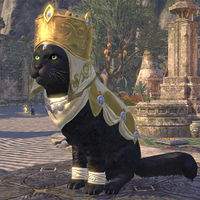
An Alfiq (ESO)
-
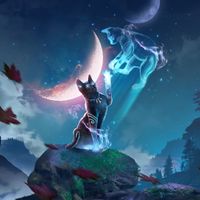
An Alfiq (Legends)
-
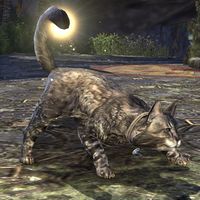
An Alfiq spellcasting through her tail (ESO)
-
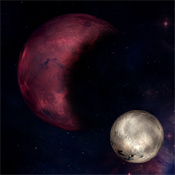
Alfiq are born when Masser is waning and Secunda is full[18]


Alfiq-raht[edit]
Little is known of the Alfiq-raht's appearance except that they are slightly bigger than the Alfiq.[61][UOL 3] They are said to make great leaders.[74] They are sensitive about being mistaken for Alfiq, as their larger size is considered a matter of pride.[61] "As crazy as an Alfiq-raht in heat" was used as an expression in the Second Era.[75]
-
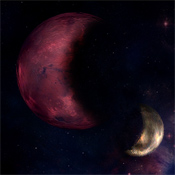
Alfiq-raht are born when Masser is waning and Secunda is waxing[74]

Cathay[edit]
Cathay are slightly larger and stronger than Suthay-raht, but the most obvious difference is that they have plantigrade legs.[76][77][UOL 5]
-
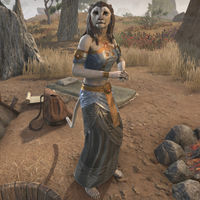
A Cathay (ESO)
-
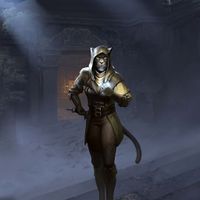
A Cathay (Legends)
-
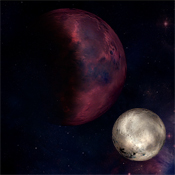
Cathay are born under when Masser is waxing and Secunda is full


Cathay-raht[edit]
Khajiit of this furstock were nicknamed as "jaguar-men" by the Imperial Geographical Society,[18] though many do not actually ressemble jaguars.[61] They are said to be more agile than a werewolf,[78] and make great warriors.[74] They possess phallic barbs.[79][UOL 6]
-
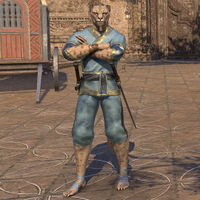
A Cathay-raht (ESO)
-
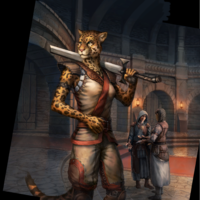
A Cathay-raht (Legends)
-
Cathay-raht are born when Masser and Secunda are waxing


Dagi[edit]
Dagi are a less common form of the Khajiit, living in the southern marshes and jungle regions of Elsweyr, as well as the Tenmar Forest.[74][61][UOL 1] Physically, they have facial features that are comparable to that of lynxes and are short in stature, making them among the smallest of the furstocks.[80] Due to their light weight, they have been reported as being able to dwell in higher branches of trees that cannot hold a Bosmer.[81] There are said to be entire communities of Dagi that live on branches.[61] Due to their inclination to climb trees, they are compared to monkeys, though this is considered insulting.[80] However, some folklore claims that a mummified Dagi paw can grant wishes at a price,[82] mirroring the stories of Monkey paws among the Bosmer.[83] Dagi are said to be skilled spellcasters, similar to the Alfiq.[61][74][81]
-

A Dagi (ESO)
-
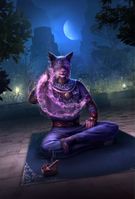
A Dagi (Legends)
-
Dagi are born under Masser waning and Secunda new


Dagi-raht[edit]
Similar to Dagi, Dagi-raht's facial features typically resemble that of lynxes, but some variations exist.[84] They are slightly larger than the Dagi, however the difference between them is considered the slightest of all furstocks.[61] They also prefer to live among the trees rather than on the ground,[85] and are reported to live in the Tenmar Forest.[61] Due to their stature and light frame, they are able to dwell in the higher jungle branches that cannot hold a Bosmer's weight.[81] Additionally, they are suspected to have more talent with magic than outsider stereotypes would suggest, though this is a generality. Much like with other races, levels of talent vary between individuals.[85][81] They are said to be especially knowledgeable of Mysticism.[74]
-
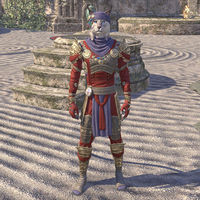
A Dagi-raht (ESO)
-
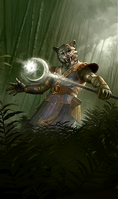
A Dagi-raht (Legends)
-
Dagi-raht are born when Masser and Secunda are waning


Ohmes[edit]
Ohmes are said to resemble elves,[74] specifically Bosmer, though they are sometimes shorter. To avoid being mistaken as such, many Ohmes tattoo or paint their faces to resemble a feline aspect.[14][61][UOL 1] They have also occasionally been described as man-like[81] and man-faced. They are said to be the only furstock not to receive the blessing of fur.[61][74] They are said make excellent infiltrators.[74] The Imperial Geographical Society has claimed them to be the most common kind of Khajiit to be encountered outside of Elsweyr, usually as adventurers or diplomats.[18]
-
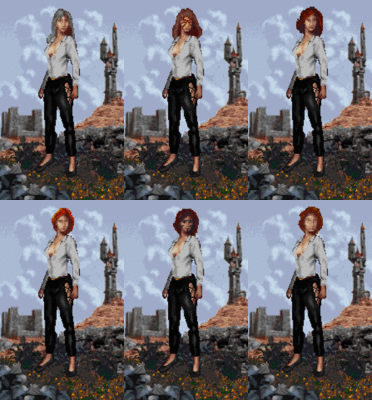
Various Ohmes (Arena)[UOL 6]
-
Ohmes are born when Masser is new and Secunda is full


Ohmes-raht[edit]
Like Ohmes, they can easily be mistaken as men or elves.[18][1][81] Though, they are said to resemble men more.[74] Just as men, they also walk on their heels. In contrast to men and mer, the body of an Ohmes-raht is covered by light fur,[74][UOL 1] and they do have a tail.[74][61][UOL 1] It is said they can be found among kings of men.[74] As Ohmes, they also paint their faces to resemble a feline-aspect.[15][61] The spirit Boethra has been depicted as distinct from any known furstock, but displays some similarity to the Ohmes-raht.[86]
-
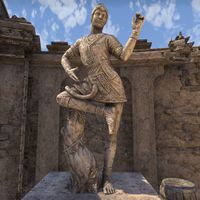
An Ohmes-raht statue
-
Ohmes-raht are born when Masser is new and Secunda is waxing
.jpg)


Pahmar[edit]
Pahmar are a giant bipedal furstock that are similar to their bigger counterparts, the Pahmar-raht, and resemble Senche-Tigers.[87][UOL 1] They are often employed as bodyguards and warriors.[61][74]
-
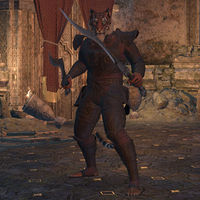
A Pahmar (ESO)
-
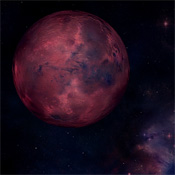
Pahmar are born when Masser is full and Secunda is new


Pahmar-raht[edit]
The Pahmar-raht are a giant bipedal furstock. They are described as the greatest generals and strategists among the Khajiit.[74] Due to them being the strongest of furstocks, they are usually deployed as bodyguards and warriors.[88] Like the Pahmar furstock, most resemble Senche-Tigers,[89][61] but Pahmar-raht differ in that they are larger and more dangerous.[61][UOL 1] They have plantigrade legs and are very tall.
-

A Pahmar-raht (ESO)
-
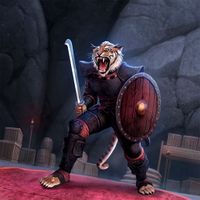
A Pahmar-raht (Legends)
-
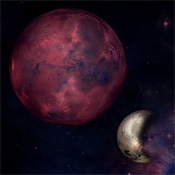
Pahmar-raht are born when Masser is full and Secunda is waning


Senche[edit]
Senche are often confused with their tiger-sized, catlike, and lesser sentient cousins, Senche-Cats.[18][62][90] This is due to Khajiit also using the term Senche to describe them.[UOL 2][UOL 8] They are described as "Great Chiefs of Lesser Cats", and their souls are said to be purest and most incorruptible of all Khajiit.[74]
The Senche furstock is said to be similar to Pahmar-raht in size. They are very large, standing about as tall as an Altmer or having a shoulder height of a Horse. Some say their weight is comparable to that of twenty Altmer, which may be a bit of an exaggeration. Their forelimbs are thick, and their rear limbs are only half as long, giving them an apelike appearance. They have tawny fur, ribboned with stripes the color of dried blood.[3] Some may use them as steeds if the Senche permits them to.[18][UOL 1]
-

A Senche
-
Senche are born when Masser and Secunda are full


Senche-raht[edit]
Nicknamed "battlecats", the Senche-raht are larger and slower than the Senche. They possess a shorter body-span and straighter legs. The average Senche-raht is said to stand as tall as two Altmer and can weigh as much or more than fifty. However, these measurements may be exaggerated.[59] Nonetheless, they are the largest of all Khajiit furstocks.[61][UOL 2] Due to their appearance, Senche-rahts are often mistaken for beasts outside of Elsweyr and may be attacked on sight.[63] Senche-rahts are intelligent beings with great memory,[91] are capable of speech,[92] and can cast spells.[93] Although like the Senche, they can function as mounts and beasts of burden and war, they dislike being lowered to a beastly status. They prefer to be seen as equals and dislike when their riders are labeled as owners and handlers.[91] Non-Khajiit may assume Senche-raht cannot speak the common language, or that they merely serve as mounts.[94] This assumption is incorrect, as Senche-raht are perfectly capable of performing jobs, and have even become successful merchant lords.[95]
Senche-raht are excellent hunters,[96] and some prefer to acquire their everyday meals by hunting animals in the wilderness.[94][97]
-
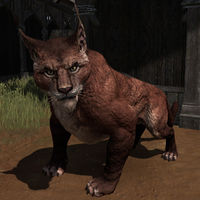
A Senche-raht (ESO)
-
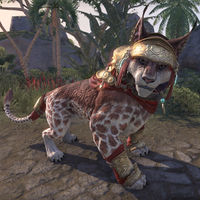
An armored Senche-raht (ESO)
-
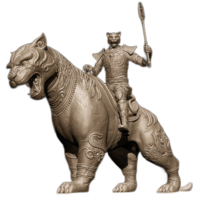
A statue of a Senche-raht in Rimmen (ESO)
-
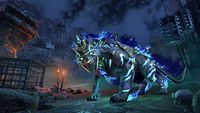
A cursed dro-m'Athra Senche-raht (ESO)
-
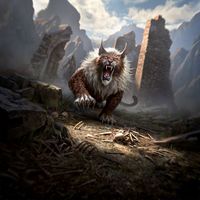
A Senche-raht (Legends)
-
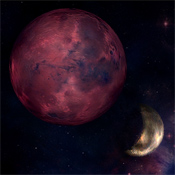
Senche-raht are born when Masser is full and Secunda is waxing


Suthay[edit]
They are similar to the Suthay-raht, save that they are of lesser stature.[61][UOL 1] Like Suthay-raht, they are evidently bipedal and have digitigrade legs.[98] Their role in Khajiit society is believed to involve being prepared for the end of time.[74]
-
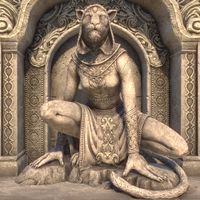
A Suthay statue (ESO)
-
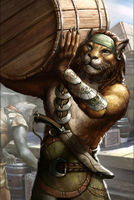
A Suthay (Legends)
-

Suthay are born when Masser and Secunda are new[57]


Suthay-raht[edit]
The Suthay-raht are sometimes, incomprehensibly for Khajiit themselves, nicknamed "ja'khajiit".[UOL 1] They are similar in height and build to the races of man, but like Suthay, they have digitigrade legs. They are completely covered in fur of different colors and patterns and have a tail. Claws are present on hands and feet, and their heads appear very cat-like.[99] Suthay-raht are known to be good jumpers, agile, sneaky and having a bold spirit. This makes them good adventurers and traders. They are however not as good warriors as Cathay-raht.[100] They are said to be fit to endure harsh punishment, described as burden bearers.[74] Suthay-raht are able to purr and hiss.[101] They also have slight phallic barbs.[UOL 6]
The Suthay-raht furstock was the most common in Morrowind,[62][UOL 1] specifically on Vvardenfell, towards the end of the Third Era.[100]
-
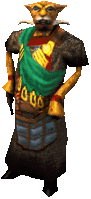
A Suthay-raht (Redguard)
-
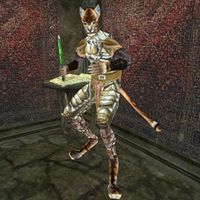
A Suthay-raht (Morrowind)
-
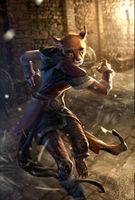
A Suthay-raht (Legends)
-
Suthay-raht are born when Masser is new and Secunda is waning


Tojay[edit]
Little is known of the Tojay, except that they live in the southern marshes and jungle regions of Elsweyr,[61] as well as the Tenmar Forest.[UOL 1] They are said to be much like the Cathay, and unlike the Tojay-raht, the Tojay may have plantigrade legs.[61][102] Tojay are known to be dancers,[102][74] and they are said wield strange magics.[74]
-
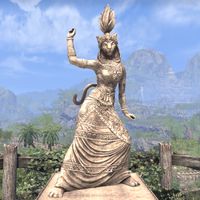
A Tojay Statue
-
Tojay are born when Masser is waxing and Secunda is new


Tojay-raht[edit]
Little is known of the Tojay-raht, except that they evidently are bipedal and have digitigrade legs.[103] They are known as masterful fighters.[74]
-
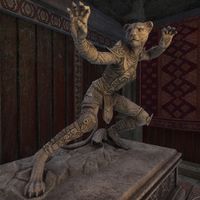
A Tojay-Raht statue
-
Tojay-raht are born when Masser is waxing and Secunda is waning


Mane[edit]
The Mane is a unique kind of Khajiit. Khajiit tradition holds that only one Mane can be alive at one time and, more specifically, believe that there is actually only one Mane who is reborn again and again in different bodies. There has been no recorded incident of more than one Mane contending for power, although whether due to the truth in the Khajiit belief or whether the ruling Mane takes care of any potential rivals is unknown. Manes can only be born under the eclipse, a rare alignment of Masser and Secunda. According to legend, a third moon known as the Dark Moon appears during this time, and people born during this time period are susceptible to becoming dro-m'Athra.[104][105] In older days the Khajiit would shave off their manes in deference to the Mane, braiding them into locks which the Mane would incorporate into their own mane. The Mane in those days was so weighted down by the hair that movement is difficult without aid and they often travel the countryside by means of a palanquin.[106][107] Rid-Thar-ri'Datta's headdress was woven from the manes of two dozen chieftains.[108] As the population grew, however, this became impractical. The Khajiit still remove their manes in honor of the Mane, and the Mane in turn wears a headdress that has the hair of the Mane's tribe and Warrior Guard attached to it, which includes several hundred in number.[18]
-
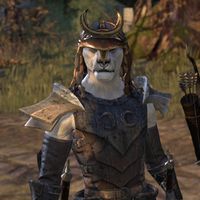
Mane Akkhuz-ri, Note the braids on his headdress (ESO)
-
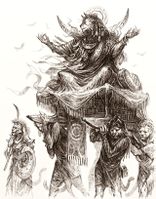
Depiction of the Mane
-
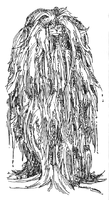
Mane Nhad-hatta, wearing the braids and hair-locks of his entire tribe


Religion[edit]


A monomythic society, the Khajiit are educated in their beliefs by the figures within their communities known as "Clan Mothers", whose duty it is to disseminate the cultural myths among their kind, and who maintain autonomy from the Mane and the disparate tribal leaders.[20]
The Khajiiti pantheon encompasses myriad Aedric and Daedric gods,[110] which are recognized as spirits,[86] a fraction of which are detailed below. Various gods rose and fell out of prominence over the eras due to events and cultural changes. Indeed, after the unification of Anequina and Pellitine into one kingdom, and the event known as the Riddle'Thar Epiphany, the Riddle'Thar cult would rise and scrub many of these spirits from the Khajiit pantheon,[86] and those that refused to follow the new edicts of the Ephiphany faced persecution.[111]
Prior to the Riddle'Thar replacing the ancient theology of the Khajiit, ancient texts were written by Amun-dro, the Silent Priest, who categorized the spirits as Sky, Worldly, Wandering, Dark, or Adversarial Spirits. Some that hold the modern religious beliefs of the Riddle'Thar consider these writings a blasphemy due to their deference and respect for darker spirits, such as suggesting Azurah walked the realm of Hermorah as a friend. Additionally, they were considered dangerous due to the fact that they were created during the time that Khajiit held scattered beliefs, with sixteen different faiths competing against each other, that "tumbled and scratched their way through history, competing for the souls of all Khajiit." However, this did not stop Khajiit from seeking out the knowledge of the ancient beliefs that had been displaced.[112]
Featured prominently in a Khajiit's spiritual journey is "the Path", a road they take during their journey through life, while avoiding temptations that would lead them astray so they could ultimately reach a sort of enlightment. To modern Khajiit, this would be the Riddle'Thar theology, and how each Khajiit reaches their fate or place in the universe varies per Khajiit. It can mean finally achieving the right to rule for those of royal blood, or simply perishing.[113] Amun-dro's writings detail the "Many Paths of time",[105] where ancient Khajiit looked to their various spirits as a source of guidance (or avoidance) to reach their destinations. There is many examples of how the spirits fulfill a role in the various Paths, whether by aiding or hindering Khajiit during their journey.[114] These Many Paths were created by Akha after he left behind trails as he explored the heavens, and were inherited by Alkosh, who is aided by Khenarthi, who helps him ensure the tapestry of time is mended.[115] Some believe that when the Riddle'Thar replaced the Many Paths with his one true path of the moons, he hid Khajiit from the other viable Paths.[116]
It is unsurprising that the most prominent among the spirits was Azurah, the Mother of All Khajiit. She bound the forms and unified the spirits of all Khajiit by tying them to the Lunar Lattice,[117] and thus is the reason why they are not bound to fate, and may instead forge their own futures. Forming a connection with her was the first step on the Path, her "twilight path", which is "the path to love and redemption".[118] At the end of a Khajiit's Path, they are reunited with Azurah along with the souls of all other Khajiit[117] at the Gates of the Crossing behind the Lunar Lattice, which they will cross to reach the afterlife beyond.[118]
There were other examples of helpful spirits, such as Mafala who watches over Eight of the Many Paths, and teaches to "Lust for nothing but Truth.",[115] Boethra, the patron of warriors and rebellious exiles,[86] and Hircine, who guides Khajiit back to the Path should they get lost.[119] The barrier of going through the Path are the challenges posed by many hostile spirits, a sample which are Sheggorath and his Madness,[120] Sangiin and his Lust without purpose,[119] and most notably Namiira, who is responsible for corrupting Khajiit souls.[121]
Modern Khajiit hold the virtues given to them by the Riddle'Thar as sacred, which tells how modern khajiit must live. As prophesied by the First Mane of the Epiphany, They must be curious (to avoid Lorkhan's deceptions), clever (to navigate the hardships of life), kind (to "blaze a trail for the downtrodden to follow"), pious (to avoid Namiira's temptations), and wary (of the other races, as well as the dangers of Oblivion). These virtues, along with some of the spirits that are approved after the Riddle'Thar Epiphany, are detailed in the book, the Secrets of the Riddle'Thar.[122] Some believe that when Riddle'Thar guided Khajiit along his so called one true path of the moons, he hid Khajiit from other viable paths.[123]
Khajiit also venerate saints. One of them led the settlement of the Stitches away from shame. Another known saint was Yosito. It is believed that although saints do not live forever, "the dead recalled in good memories are the true saints of our lives."[124]
Origin[edit]

On the origin of their species, the Khajiit believe that life originated with two litter-mates, Ahnurr and Fadomai, who gave birth to the first cat, Alkosh.[20] To Alkosh was given the guardianship of time, and whose birth prompted Ahnurr and Fadomai to bring forth further life into the world, thus they created Khenarthi, guardian of the winds; Magrus, guardian of the sun; Mara, guardian of love; and S'rendarr, guardian of mercy.[20] In time, Ahnurr and Fadomai wished to share the happiness they felt in life with further children, and so, Fadomai gave birth to Hermorah of the tides, Hircine of hunger, Merrunz of destruction, Mafala of the Clan Mothers, Sangiin of blood and life, Sheggorath of insanity, and many others.[20]
Ahnurr decided to stop having children since further offspring would dilute their happiness. However, Fadomai was persuaded by Khenarthi - who had grown lonely in the realm of the winds - to give birth to further children, and this she did, bringing forth Nirni, the majestic sands and lush forests, and Azurah, the dusk and dawn, as well as the Moons and their Motions. It was at the time of her birthing that Fadomai was caught by Ahnurr who, angered at her trickery and disobedience, struck her. She, fearing for her life and children, fled with them to the Great Darkness and hid, giving birth to her final child, Lorkhaj. Having been born amidst the Great Darkness, Lorkhaj's heart was filled with such, and thus was made aware of itself and then known as Namiira.[20]
Amidst the darkness, surrounded by her children, Fadomai realized her death was near and set the moons, Jone and Jode, in the skies to guide her children and protect them from Ahnurr's wrath. She gave Nirni her "greatest gift", proclaiming that she would give birth to as many children as Fadomai had. Nirni was pleased because Azurah, with whom she routinely squabbled, had been left with nothing. Protected by the Lunar Lattice, the children of Fadomai left, save for Azurah, who approached her mother and was then given her gifts in the form of three secrets. She was told to take one of Nirni's children and change them, making them the fastest, cleverest, and most beautiful of creatures, naming them the Khajiit; second, that they must be fashioned as the best climbers, to climb upon the winds of Khenarthi's breath and set Masser and Secunda aright, lest they fail; lastly, that the Khajiit must be the best deceivers, able to hide their true nature from others. Then Fadomai died, and Azurah left to join her kin.[20]

Nirni approached Lorkhaj, whom she asked to create for her children a dwelling; he did so, and yet the Great Darkness in his heart influenced him to deceive his siblings so that they would be trapped in the new place with Nirni. Some managed to escape death and become the stars, and those who remained punished Lorkhaj by tearing out his heart and hiding it deep within Nirni, so that he would be with her whom he had done the most harm.[20] Pre-ri'Datta texts state Lorkhaj survived and fled to Azurah with a wound in his chest, where she saw Namiira dwelling within as a corruption resembling a heart. Azurah cleansed Lorkhaj and flung his Dark Heart into the Void, and Lorkhaj perished within Azurah's embrace.[125] From this false heart came the twisted shade of Lorkhaj known as the Moon Beast, first of the dro-m'Athra. Thus Lorkhaj represents the duality of Khajiiti souls and their susceptibility to the Bent Dance,[126][121] which calls them to darkness through the "beating drum of the Dark Heart in [their] moments of deepest sorrow or most anguished regret."[127]
Upon the new world of Lorkhaj's creation, Nirni came to give birth to her children, who were many, but wept bitter tears for her favorite—the forest people—who did not know their proper shape. It was at this time that Azurah came forth and comforted her, promising to make new people for Nirni as a gift. She spoke Fadomai's First Secret, and the Moons parted for her, and she took some of the forest people and placed them in the deserts and forests, where she fashioned them in many forms, one for each purpose they might need, and having done so, named them the Khajiit. Azura then told them the Second Secret and made them Nirni's "secret defenders", and bound them to the Lunar Lattice. And she then spoke the Third Secret, and making the light shine down upon the marshes where they became the crystallized moonlight known as Moon-Sugar,[20] a substance holy to the Khajiit.[18][20] Though some ancient traditions credit Hircine (who sphere represents skinchanging) with fathering the precursors of the Khajiit,[119] the act of a Khajiit changing their Lunar Lattice-given form for another is considered taboo in most circles.[59]

Khenarthi shared her domain with the other Sky Spirits—Magrus in the day, Jone and Jode at night, and Azurah in between—although she still suffered from loneliness as their company depended on the time of day. Seeing her grief, Azurah shared a secret with Khenarthi, making her a psychopomp that would accompany the spirits of deceased Khajiit to the afterlife of Llesw'er, the Sands Behind the Stars.[128] From Llesw'er, these spirits await until the Next Pounce,[129] for Khenarthi will call upon their combined might to fight for creation at the end of time.[126] Namiira is the antithesis to Khenarthi, who drags the victims of the Bent Dance into the Dark Behind the World, where they become part of her dark litter. Those of this litter occasionally slip through the cracks in Nirni to tempt true cats, so their souls can too be sent to the Dark to serve Namiira as dro-m'Athra.[129] To combat Namiira's dark litter and save Khajiiti souls from corruption, from Azurah's tongue came the Dusk-Canticles, holy hymns used to exorcise dro-m'Athra.[130] And so explains the fight for the souls of Khajiit.
When Azurah was speaking the secrets, the first was heard by Nirni's mate, Y'ffer, who told Nirni of Azurah's deed. Nirni, in retribution for her changed and now lost children, made the deserts hot and sands biting, and filled the forests with water and poison. To separate her beloved children from those of Azurah, she allowed Y'ffer to change those who remained so that they would always be of the mer, and never beasts, and named them Bosmer. From that moment forth, the two were eternally separated and, as with their makers, were bound in animosity one with the other. Pre-ri'Datta texts claim that Namiira would later further escalate their hostility by corrupting Y'ffer, who would then kill Nirni. Azurah, Khenarthi, and Hircine would then avenge her and make a cairn for Nirni out of Y'ffers' bones.[119] In this fashion, the Khajiit explain not only their origins but their bond with the moons and conflict with the Bosmer.[20]
The Reachmen shares similarities to Khajiiti origin myth, specifically around the roles Lorkhan (known to them as Lorkh) and Namira had in creation, as well as the existence of the Dark Heart. Reach belief differs in that Lorkh willingly sought out Namira, who ruled the world of spirit, and convinced her to grant him a place in the infinite void to create the realm of flesh, an unforgiving place that teaches through suffering. To make this a possibility, Lorkh sacrificed himself to create a harsh realm, which released the darkness left in his heart .[131][132]
The Bosmeri creation myth does complement the Khajiiti myth, as both speak of shapeless entities. And like the Khajiiti creation myth, Y'ffer (or in their naming scheme, Y'ffre) is indeed credited with giving a shape to the Bosmer.[133]
Of the surviving letter fragments by Topal the Pilot, the following passage tells of his encounter with the ancient ancestors of Khajiit sometime during the Middle Merethic Era.
|
|---|
The theories of Imperial scholars contradict the Khajiiti origin story. These "cat demons" reported by Topal are interpreted as evidence to Imperial scholars for their belief that Khajiit are the descendants of a race of great cats.[14][15] These great cats are said to have originally walked on four paws but eventually learned to walk on two feet and became the leading predator of Elsweyr.[16] However, the ancient ancestors that Topal encountered fit the description of both quadrupedal and bipedal furstocks, giving more credence to these cats simply being ancient Khajiit bound to the Lunar Lattice.
These origins may be further debated, as Pelinal Whitestrake, leader of the Elven Pogrom, slew many thousands of the Khajiit, during the same era, under the mistaken impression that they were "another strain of Aldmeri" so closely did they resemble such. There are other such reports, and they raise the possibility that the Khajiit, in general, may actually have elven ancestry.[1]
Khajiiti Pantheon[edit]
As previously mentioned, Khajiit worship both Aedric and Daedric gods which they refer to as spirits.[110][86] Many of these spirits have faded into obscurity, a result of many factors, such as the scrubbing of the pantheon by the Riddle'Thar cult,[86] and the fear of being persecuted for keeping to the older faith.[111] For simplicity, the following section categorizes the spirits as they are in the pre-ri'Datta texts written by Amun-dro, the Silent Priest, who sorted them as Sky, Worldly, Wandering, Dark, or Adversarial Spirits.[114] This type of categorization is still seen to an extent in the modern Khajiiti Religion.[19]
The Sky Spirits[edit]

Azurah (Mother of All Khajiit / Goddess of Dusk and Dawn / Queen of the Night Sky / Favored Daughter of Fadomai)
The Khajiit name for Azura. She is the Sister to Nirni, the plane, and goddess upon which the Khajiiti dwell, Azurah is the goddess to whom the Khajiit attribute both their current form and the mysterious tie between them and the Lunar Lattice. She makes few appearances among Khajiiti myth apart from that of their origin.[19] In some art, she is represented as a Khajiit with oversized eyes and star-like pupils.[134] In others, she depicted with three faces—of a Khajiit, a Mer, and a Human woman. Ancient Khajiit considered her an ancestor spirit and a teacher of the old ways.[117]
Jode (Big Moon God / The Ever-Mourned)
One aspect of the Lunar Lattice, Jode is revered uniquely by each sub-species of Khajiit, as regards their aspect at the time of the Khajiit's birth.[19] Ancient Khajiit knew Jode as the lantern of love.[125]
Jone (Little Moon God / The Ever-Mourned)
One aspect of the Lunar Lattice,[19] Jone is revered uniquely by each sub-species of Khajiit, as regards their aspect at the time of the Khajiit's birth. Ancient Khajiit knew Jone as the lantern of mercy.[125]
Khenarthi (Goddess of the Winds / Gatherer of Waters / Elder Spirit of the Heavens)
The Khajiiti name for Kynareth.[135] Little is known of the worship of Khenarthi, whom the Khajiit hold to be the Goddess of the Winds, whose breath sustains her kin, Jode and Jone, on their path through the sky. She is also credited with aiding the Khajiit with swiftness.[19] When "true cats" die, Khenarthi flies their souls to the Sands Behind the Stars.[129] She is usually represented as a great hawk, and is popular among sailors and farmers.[136] When worshiped in her agricultural aspect, she is known as the Gatherer of Waters.[137]
Magrus (Cat's Eye, Sun God, Third Eye of Azurah)
The Khajiit name for Magnus. Known to them as the god of the sun and sorcery, although Khajiit magicians revere Azurah more.[19]
The Worldly Spirits[edit]

Hermorah (The Watcher, Spirit of the Tides, Tide-King)
He is comparable to Hermaeus Mora and is associated with the Tides.[20] Hermorah is said to live within a vast library beneath the waves, where he records everything he has witnessed. This place also functions as collection of knowledge from Others (i.e. Non-Khajiit)[119] In some ancient stories, he is linked with Azurah as a friend, having helped her maintain the moons' paths after the world's creation.[119][138] However, more recent writings do not understate the danger of approaching Hermorah for guidance. His knowledge is likened to tearing the mind apart like the "most potent skooma".[138]
Hircine (The Hungry Cat, The Hunter, Spirit of Pursuit and Purposeful Change)
He is the god of hunting and skin-changing, revered for his fierceness and cunning.[19] Some tribes of ancient Khajiit believed Hircine to be the father of Nirni's first litter, who were "as changeable as the Moons".[119] This litter would later have their form stabilized by Azurah, who bound their forms to the Ja-Kha'jay.[126] Ancient Khajiit prayed to Hircine when they have "strayed from the Path", and believe he will guide them back upon it.[119] Modern Khajiit still worship him, and to gain his favor, the Khajiit partake in a hunt and offer their game in hopes that he will reward them by strengthening their claws and sharpening their senses.[50]
Nirni (The Green Mother / Spirit of Harmony)
Nirni is the personification of Nirn and is considered the mother of all mortal life in the Mundus.[119] She is one of the children of Fadomai's third litter, along with Jone, Jode, Azura and Lorkhaj.[20] From birth, Nirni and Azura were rivals and fought for their mother's favor which lead to one of her epithets as the Jealous Sister. This jealousy is used in some tales to explain the harshness of the Khajiit homeland, as a response to their status as Azurah's favored people.[119][20]
On Fadomai's deathbed, she gifted Nirni with knowledge that she would become the mother of numerous children. In turn, it was Nirni who asked Lorkhaj to create a place so she could birth them. This resulted in Lorkhaj's trickery of the other spirits and his subsequent punishment.[20] Various stories have romantically linked Nirni to both Y'ffer and Hircine, with some stories claiming that the latter fathered some of her children.[119] Modern Khajiit recognize Azurah's role in taking some of Nirni's children and transforming them into the first Khajiit, as per Fadomai's instructions to be the secret defenders of the world. In response to the changing of their shapes, Nirni punished the Khajiit by making their lands arid and barren.[139][20]
Some of the myths prior the Riddle'Thar Epiphany claim that Nirni was slain by Y'ffer in a bout of madness. Despite her diminished spirit, her presence is said to be still felt in the unsullied wilds of Nirn.[119]
Sangiin (Blood Cat / Blood God of the Second Litter / God of Death and Secret Murder)
Little is known of Sangiin, though he is comparable to the Sanguine. He is the god of Death and Secret Murder, and his worship is hidden from Magrus.[19] He is revered by some vampires, who perform blood sacrifices for him through hemo helots.[140] He is prayed to in secrecy in forbidden shrines.[141]
Y'ffer (The Elden Shaper)
Y'ffer the equivalent of Y'ffre in the Khajiit pantheon, and much like the latter is considered the creator of the Bosmer.[20] Despite his appearance in Khajiiti myth, he is not considered a figure of worship. Prior the Riddle'Thar Epiphany, he was was recognized as a bastard son of Ahnurr, though his temperament was the opposite of his father's.[119]
Of the known stories involving Y'ffer, he often linked with Nirni. In older traditions, Y'ffer became Nirni's mate after creating the first flower for her and fathered many of her children.[119] In more recent stories, such as those attributed to Clan Mother Ahnissi, this aspect of their relationship is downplayed. Y'ffer is portrayed as nosey spirit that can't keep secrets, eavesdropping on Azurah's creation of the Khajiit and promptly telling Nirni what he overheard. In gratitude, she allowed Y'ffer to alter some of her children in the same manner, which became the first Bosmer.[20] These same stories also hold Y'ffer responsible for "Fadomai's Children" (i.e. Daedric Princes) being able to cross the Lattice and enter Nirn.[20]
Sometime after the death of Lorkhaj, Y'ffer also became corrupted by the Great Darkness and killed Nirni. In response, he was destroyed by the combined efforts of Azurah, Khenarthi, and Hircine. Afterwards they used his bones to create a cairn for Nirni.[119]
The Wandering Spirits[edit]

Akha (The First Cat / Pathfinder / One Unmourned)
A Pre-ri'Datta deity, he is one of the eldest children of Ahnurr and Fadomai. Early in his existence, Akha explored the heavens and his trails became the "Many Paths", forming myriad kingdoms. At his father's advice to find love, he mated with the Winged Serpent of the East, the Dune Queen of the West, and the Mother Mammoth of the North. He is said to have disappeared when he traveled south. In his place, Alkosh emerged to warn the others of the things Akha had created while traveling the Many Paths.
After this, Alkosh assumed the rule over Akha's kingdoms and watched over Akha's many children, "for they are both terrible and kind".[115]
Alkhan (The Scaled Prince / Firstborn of Akha)
One of the known children of Akha, who is said to have come from a union with a demon. Alkhan was said to grow in size after consuming the souls of those he killed. Some legends state that he was slain by Lorkhaj and his companions, but other sources like Amun-dro suggest that Alkhan would eventually return from the Many Paths.
He is considered the enemy of Alkosh, Khenarthi, and Lorkhaj.[115]
Alkosh (Dragon King of Cats / The First Cat / God of Time)
A cultural hero, and one of the earliest gods among the Khajiit culture, his worship was co-opted during the establishment of the Riddle'Thar, although worship of Alkosh as a deity continues to flourish among Elsweyr's desert-blasted regions. Most commonly depicted as a fearsome dragon with feline features, the Khajiit typically describe Alkosh as "a real big cat". He repelled an early Aldmeri pogrom of Pelinal Whitestrake, leaving a time wound in its place. The Khajiiti built the temple of Sunspire where the time wound lay to honor him, and believe that without his divine intervention, Pelinal would have wiped them out.[19][142] Khajiit believe that Alkosh is their dragon-father who gave them their strength. Some interpret that link as them being both cat and Dragon.[143]
In the modern Khajiiti pantheon, Akha is absent and Alkosh instead takes his place as the First Cat.[20]
Boethra (The Warrior of the East and West)
The Khajiit name for Boethiah, little is known of her worship. She is a sharp-tongued[118] ancestor spirit and a teacher of the old ways,[117] and the patron of warriors and rebellious exiles.[86]
Mafala (Clan Mother of Dark Secrets / The Teaching Mother / Elder Spirit / Keeper of the Ancient Secrets of Fadomai)
The Khajiit name for Mephala. While she is known to be the recorder of hidden guilt and eternal shame, Mafala is also considered an ancestor spirit and a teacher of the old ways.[117] However, her worship fell out of favor after the event known as the "Sinner Suicides".[144] She is an ally of Azurah, Boethra, and Lorkhaj.[115]
The Dark Spirits[edit]

Namiira (The Great Darkness / The Eldest Spirit / The Void/ Ur-Dra)
The Khajiit name for Namira, Namiira is the Great Darkness found within Lorkhaj's heart and the void from which he was born. Some outsiders believe that the Khajiit entrust the souls of the dead to Namiira,[145] but this is actually Khenarthi's role. Namiira is the spirit that drags the souls of bent cats to the Dark Behind the World, where they serve her as dro-m'Athra.[129]
Noctra (The Shadow Thief / Daughter of Twilight)
The Khajiit name for Nocturnal, much that is known about her predates the Riddle'Thar Epiphany. She was born from the black blood of Lorkhaj at the steps of the Void Gate. In the songs, Boethra battled this spirit until it knew it was not Namiira. When this was done, Noctra was brought before Azurah to be judged. Azurah showed mercy and allowed Noctra to live, so long as she served Azurah and the ja-Kha'jay. But Noctra is rebellious by nature, so she stole one of Azurah's keys and fled back into the Void. It is written that Azurah sent the true spirit of Lorkhaj to find her, and ever since Noctra has aided the Khajiit when called. Tribes may whisper to Noctra for silence, shade, and luck. Do not summon her to perform vile deeds, for this will bring the Dark with her.[121]
Varmiina (Queen of Nightmares / The Lost Daughter)
The Khajiit name for Vaermina, Much that is known about her predates the Riddle'Thar Epiphany. This spirit was not of any litter but was born from Fadomai's fear of losing her children. Azurah killed this dark spirit in the Underworld, and now Varmiina only haunts Khajiit when they dream. Know she will test you and make you want to turn from the Path in fear, but she cannot truly harm the ja-Kha'jay in dreams.[121]
[?????]
A spirit of vengeance with no will of its own. Its true name is known only by Azurah, Boethra, and Mafala, and can only be summoned by them. It appears in songs as a black panther, a warrior in ebony armor, or as a hidden sword. Its existence is acknowledged in texts that predate the Riddle'Thar Epiphany. [121] It shares similarities with Ebonarm.
The Adversarial Spirits[edit]

Merid-Nunda (False Spirit of Greed / The Orphaned Glimmer)
Merid-Nunda is also known as Meridia, ancient texts claim that she is the daughter of Magrus, who loved only himself and his own creations. Magrus did not take a mate but instead forged children of the aether. Merid-Nunda is a cold spirit, born of light without love. She is intellect without wisdom, knowledge without purpose. She is the consort of demons, and some songs blame her for orchestrating the death of mighty Lorkhaj. When Merid-Nunda dared assault the Lattice, Azurah struck her down before the Varliance Gate and dragged her away from it. She then cast Merid-Nunda into the Void and bound her there with mirrors. The nomads say she has since escaped.[120]
Merrunz / Mehrunnez[146] / Dagon[120] (Ja'Khajiit / Fire-Cat / Demon Cat)
Also known by his Imperial name Mehrunes Dagon, Merrunz is an eternally-young god of cat-like form; thus, as a kitten, do the Khajiit explain his natural tendency to rend and destroy the world around him.
Molagh (Elder Spirit of Domination and Supreme Law)
The Khajiit name for Molag Bal, he is one of the twelve Demon Kings. Ancient texts state that this demon was the first to assault the Lattice with intent, alongside Dagon and Merid-Nunda. Boethra and Molagh fought to a standstill before the Lattice, but it was Azurah who shackled the Demon King with secrets only she knows. He will test you, and you will overcome him with the might of Boethra, the Will Against Rule.[120]
Orkha
Known through texts that predate the Riddle'thar Epiphany, it is a demon sharing similarities to Malacath, it followed Boethra back through the Many Paths. It spoke in curses of affliction and knew no other words. Lorkhaj, Khenarthi, and Boethra battled the demon in the ancient songs, but Orkha could only be banished and would not die. Khajiit understand that Orkha and others of his ilk serve as tests along the Path, and nothing more.[120]
Sheggorath (Skooma Cat / Mind God)
The God of Madness, Sheggorath is easily identifiable with the Imperial Sheogorath, the negative effects of Skooma and Moon Sugar being attributed to his presence among the Khajiit.[19]
The Sky and Dark Spirit[edit]

Lorkhaj (The Moon Beast / Moon Prince / Fadomai's Favored Son / The First Trickster / The Missing God / The White Lion / Dark Moon / Ghost Moon)
Ancient texts interpret Lorkhaj as both a Sky and Dark Spirit, and he is easily identifiable with the tales of Lorkhan. As a Sky Spirit, Lorkhaj was the Moon Prince and was honored as the first spirit to make his own path, which led to him uniting the spirits to create Nirn.[126] Lorkhaj as the Moon Beast was considered a Dark Spirit due to Namiira corrupting him into the first dro-m'Athra. After his cleansing, the darkness that left him became separate being.[125] Modern Khajiit revile Lorkhaj, instead believing him to be an enemy of Khajiit,[147] and a hateful trickster that trapped them in mortal form.[141] His deceptions lie even in plain view, and are common enough to be accepted as truths.[122]
According to pre-ri'Datta beliefs, sometime before the "first memory" of the Khajiiti people, Azurah, knowing that the false Lorkhaj, the Moon Beast, would one day covet her children, used the Twin Lanterns of Jone and Jode to summon the true spirit of Lorkhaj[126] to be a sky-guardian.[148] As the third moon, Lorkhaj shined his light upon the Khajiit, choosing the purest of heart to be part of the "Litter of the Hidden Moon", where they would learn the way of the Moonlight Blade.[148] And from then on, on nights of the Ghost Moon, Azurah opens the Void Gate, and the Moon Beast will challenge mortals until banished.[121] Modern Khajiiti beliefs on the Dark Moon differ from ancient beliefs, with the birth of the Mane being the main purpose of its existence.[149] Furthermore, They believe that Lorkhaj's body was hurled to the moons, and forced to follow Jone and Jode forever as punishment.[59][150]
Other[edit]

Baan Dar (The Pariah)
Regarded more as a manifestation than a formal god, Baan Dar is the personification of Khajiiti cleverness and the wit engendered of long-suffering on their part.[19] He is commonly attributed with that genius which lends itself to the creation of last-minute plans to foil the machinations of the Khajiit's foes, man or mer.[19]
Ius (Animal God / The Extremely Agitated)
Little is known of this spirit, but was known to be a subject of worship in parts of Elsweyr sometime between 3E 405 and 3E 417, and is unknown if he was worshipped past this period. He is known as a God of Animals, and is represented by statues of a misshapen humanoid carrying a rod. The tale The Ox and The Evil Farmer tells of an Ox praying to Ius to be saved from being a farmer's dinner, to which Ius responded by eating the farmer.[151]
Khunzar-ri (The Laughing Lion / Luminous Lion of Elsweyr / Lunar Champion / Jonelight Jaunter / Imprisoner of Dragons)
An apotheosized Khajiit hero and warrior who was active during the Merethic Era.[152] Some stories elevate him to the status of a god,[153] or him being created by one.[154] He is known for his many adventures, some examples include his meeting with the Skooma Cat, and the debaucherous Night of Seven Hundred Paramours.[155] He was most well-known for capturing the Dragons who plagued the land of Elsweyr by imprisoning them in the Halls of Colossus.[156] Long after his death, he is still worshipped for his heroic deeds within Khajiiti shrines.[157]
Mara (The Mother Cat / Goddess of Love)
The Goddess of Love Mara is attributed all the passion of the Khajiit. Nothing is known of her worship among the Khajiiti.[19]
Rajhin (The Footpad / The Silent Walker)
The thief-god of the Khajiiti, legend holds that Rajhin grew up in the Black Kiergo section of Senchal. In life, Rajhin was the most infamous burglar in Elsweyr's history, said to have stolen a tattoo from the neck of the Empress Kintyra as she slept.[19][158] He is accredited with using the Ring of Khajiiti in his thievery, making the ring famous. After his death, Rajhin was inculcated among the Khajiit gods, to serve as an example to them of cleverness and adroit ability. His blessing is most often asked for before undertaking activities of a less-than-lawful nature.
Riddle'Thar (Two-Moons Dance / The Sugar God)
The cosmic order deity of the Khajiit, the Riddle'Thar was revealed to the citizens of Elsweyr by the prophet Rid-Thar-ri'Datta. The Riddle'Thar is more a set of guidelines than a single entity, although it has been known that some of his avatars appear as humble messengers of the gods to those in need.[19] Some believe that when he replaced the old ways, he usurped rich traditions with a flimsy one, and "sanded down the sharper edges of Khajiiti theology."[149]
S'rendarr (The Runt / God of Mercy)
S'rendarr is revered by the Khajiit as a god of mercy, whose spheres include compassion, charity, and justice.[19] In some Khajiit traditions he is portrayed as a runt and was birthed last in the first litter of Fadomai and Ahnurr.[20] At least one of his cults fell afoul of the followers of Riddle'Thar during the time of the Epiphany when they refused to follow its edicts.[111] In Elsweyr, the adeptoriums which devoted to S'rendarr are known as houses of healing.[159] In day-to-day lives, many will invoke S'rendarr for protection.
Gallery[edit]
-
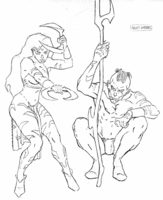
Concept art of Ohmes-raht warriors (Daggerfall)
-
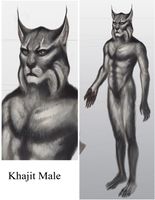
Male concept art (Skyrim)
-
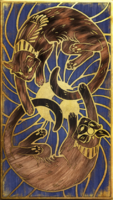
A Legends cardback depicting Alfiq
-
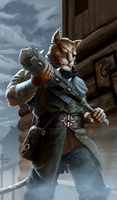
Baandari Bruiser
-
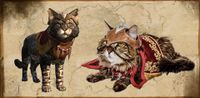
Concept art for ESO: Dragonhold depicting Alfiq
-
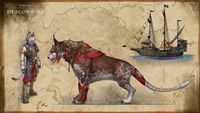
Concept art for ESO: Dragonhold depicting a male Dagi-raht (left) and a female Senche-raht (right)


Appearances[edit]
-
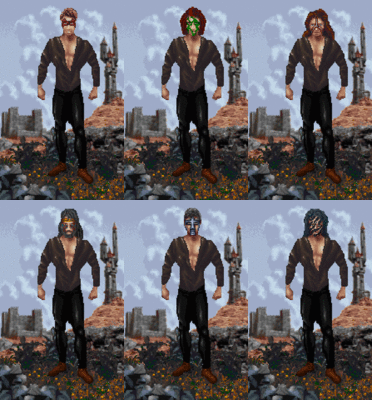
Male Ohmes (Arena)
-
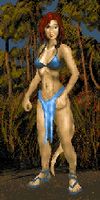
Female Ohmes-raht (Daggerfall)
-
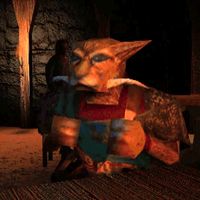
Male Suthay-raht (Redguard)
-
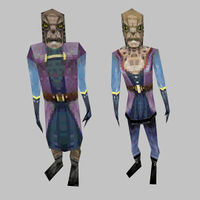
Male and female (Shadowkey)
-
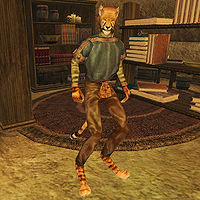
Male Suthay-raht (Morrowind)
-
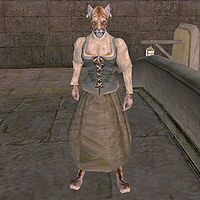
Female Suthay-raht (Morrowind)
-
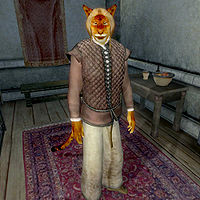
Male Cathay (Oblivion)
-
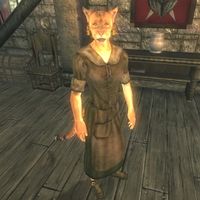
Female Cathay (Oblivion)
-
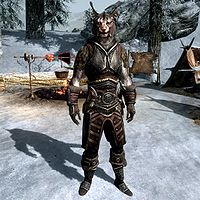
Male Cathay (Skyrim)
-
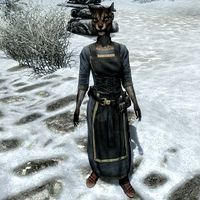
Female Cathay (Skyrim)
-
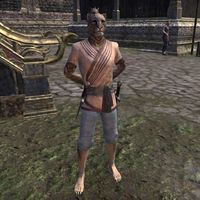
Male Cathay (ESO)
-
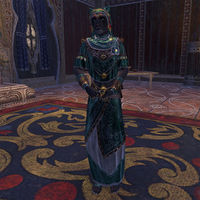
Female Cathay (ESO)
-
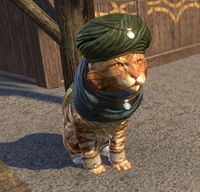
Male Alfiq (ESO)
-
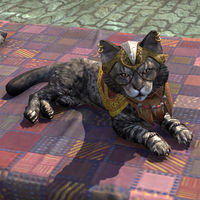
Female Alfiq (ESO)
-
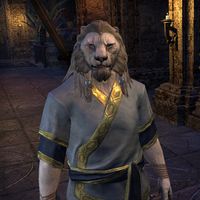
Male Cathay-raht (ESO)
-
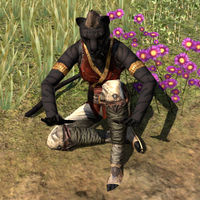
Female Cathay-raht (ESO)
-

Male Dagi (ESO)
-
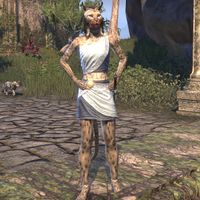
Female Dagi (ESO)
-
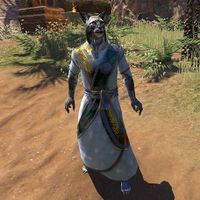
Male Dagi-raht (ESO)
-
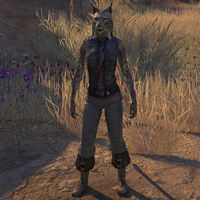
Female Dagi-raht (ESO)
-
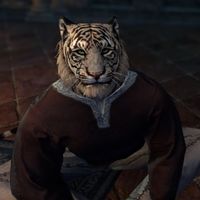
Male Pahmar (ESO)
-
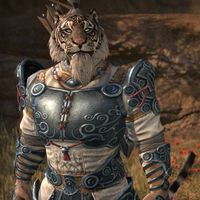
Male Pahmar-raht (ESO)
-
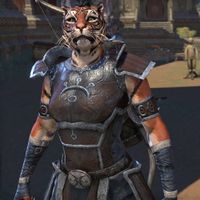
Female Pahmar-raht (ESO)
-

Male Senche-raht (ESO)
-

Female Senche-raht (ESO)
-
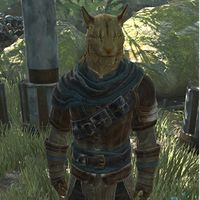
Male Cathay (Blades)
-
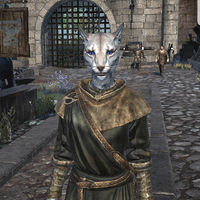
Female Cathay (Blades)

.jpg)


Notes[edit]
- Arena features Ohmes as the playable Khajiit furstock.[UOL 6] Daggerfall's Khajiit match the description of the Ohmes-Raht furstock, as they share the exact characteristics.[UOL 9] [UOL 1]
- Morrowind features Suthay-raht as the playable Khajiit furstock.[62] They were first seen in Redguard.
- Shadowkey lacks any NPC Khajiit. Khajiit are playable however, but lack a tail and digitigrade legs. An unused Khajiit model with digitigrade legs exists in the files.
- ESO features Cathay as the playable Khajiit furstock,[UOL 3] although they were previously stated to be Suthay-raht.[160]
- The moons rise in the east. Thus, the Khajiit favor that direction.[161]:175
- The Game Director of Arena, Vijay Lakshman, explains the origins of the Khajiit race: "With the Khajiit, I’d spent a lifetime as a practitioner of the martial arts, I’ve trained for 30 years, was a nationally ranked black belt and competed in over 1200 combats in the ring. I knew I wanted to make a feline race, and I saw their grace and agility as an intrinsic quality, much like a martial artist. In Japan, the art of the sword is called Kenjitsu. I modified that to become Khajiit, and thus the race of these highly nimble and agile felines was born!"[UOL 10]
See Also[edit]
- Khajiit Names
- For a list of notable Khajiit, see here.
- For game-specific information, see the Arena, Daggerfall, Morrowind, Shadowkey, Oblivion, Skyrim, Elder Scrolls Online, Legends, and Blades articles. Also see the Redguard category.
Books[edit]
- Ahzirr Traajijazeri by Anonymous — The public manifesto of the Khajiit organization Renrijra Krin
- Cherim's Heart of Anequina by Livillus Perus, Professor at the Imperial University — Interview with Cherim, a master tapestry weaver
- Crafting Motif 7: Khajiit Style by Doctor Alfidia Lupus — Being notes by DoctorAlfidia Lupus for a series of pamphlets on the major cultural styles of Tamriel
- Father of the Niben, Fragment Three by Florin Jaliil — Translation of the fragmented journal of Topal the Pilot
- Interview With Douglas Goodall (unofficial)
- Notes on Racial Phylogeny by the Council of Healers, Imperial University — About the similarities and differences between the races of Tamriel
- Pocket Guide to the Empire, 1st Edition: The Elsweyr Confederacy — Imperial Geographical Society, 2E 864
- Pocket Guide to the Empire, 3rd Edition: Sugar and Blood: the Cats of the South — Imperial Geographical Society, 3E 432
- Provinces of Tamriel — A brief analysis of the Imperial provinces of Tamriel
- Skeleton Man's Interview with Denizens of Tamriel — An interview with some Tamrielic locals (unofficial)
- Spirits of Amun-dro by Amun-dro, the Silent Priest — Pre-ri'Datta texts which lists various spirits of the Khajiiti Pantheon
- The Tale of Dro'Zira by Sonia Vette — A Khajiit father in the grips of moon-sugar gives his cub a history lesson
- Varieties of Faith in the Empire by Brother Mikhael Karkuxor of the Imperial College — An expansive list of the pantheons and associated divine spirits of Tamriel's dominant cultures
- Words of Clan Mother Ahnissi by Clan Mother Ahnissi — How a Khajiit explains the origin of the world
References[edit]
- ^ a b c d e f Pocket Guide to the Empire, 3rd Edition: Sugar and Blood: the Cats of the South — Imperial Geographical Society, 3E 432
- ^ J'zargo's dialogue in Skyrim
- ^ a b c The Infernal City — Greg Keyes
- ^ a b Notes on Racial Phylogeny — the Council of Healers, Imperial University
- ^ a b Ask Us Anything: Variety Pack 4
- ^ The Real Barenziah, v 2 — Anonymous
- ^ Guide to Leyawiin — Alessia Ottus
- ^ The Buying Game — Adabael Timsar-Dadisun
- ^ Barbas's dialogue in Skyrim
- ^ Moon Worship among the Cat-Men — Cirantille
- ^ Pacrooti's hireling correspondence
- ^ Race Description of Khajiit in TES Travels: Shadowkey
- ^ Pocket Guide to the Empire, 3rd Edition: All the Eras of Man, A Comprehensive History of our History — Imperial Geographical Society, 3E 432
- ^ a b c Race Description of Khajiit in TES:Arena
- ^ a b c Race Description of Khajiit in TES II: Daggerfall
- ^ a b The Improved Emperor's Guide to Tamriel: Elsweyr — Flaccus Terentius, 2E 581
- ^ a b Father Of The Niben — Florin Jaliil
- ^ a b c d e f g h i j k l m n o Pocket Guide to the Empire, 1st Edition: The Elsweyr Confederacy — Imperial Geographical Society, 2E 864
- ^ a b c d e f g h i j k l m n o p q r s Varieties of Faith: The Khajiit — Brother Mikhael Karkuxor of the Imperial College
- ^ a b c d e f g h i j k l m n o p q r s t u Words of Clan Mother Ahnissi — Clan Mother Ahnissi
- ^ Kyne's Challenge: A Hunter's Companion: Elsweyr
- ^ a b Discover Elsweyr & the Khajiit that Live There on the official ESO website
- ^ The March Explored — Fenlil the Wayfarer
- ^ Guide to Northern Elsweyr — Infrasia Mallius
- ^ Temple of the Hidden Moon and other places that appear in ESO: Elsweyr and ESO: Dragonhold
- ^ Khamira's dialogue in ESO: Elsweyr
- ^ a b Khajiiti Arms and Armor
- ^ Special Flora of Tamriel — Hardin the Herbalist
- ^ Crafting Motif 73: Anequina Style — Captain Nala-do,Northern Elsweyr Defense Force
- ^ Crafting Motif 74: Pellitine Style — Cashia Khrasaat-Plume, Envoy of the Mane, Torval
- ^ Response to Citizen Inquiries — Aicantar of Shimmerene, Sapiarch of Indoctrination
- ^ Sharpclaws Filing Stone item description in ESO
- ^ Sharpening Post item description in ESO
- ^ Clan Mother Tadali's houseguest dialogue in ESO
- ^ Moon-Sugar Chawbox item description in ESO
- ^ Cherim's Heart of Anequina — Livillus Perus, Professor at the Imperial University
- ^ Provinces of Tamriel
- ^ The Eastern Provinces
- ^ Brown Book of 3E 426
- ^ Pocket Guide to the Empire, 1st Edition: Morrowind — Imperial Geographical Society, 2E 864
- ^ Confessions of a Skooma-Eater — Tilse Sendas
- ^ Corpse Preparation v I
- ^ Euraxia's Personal Journal — Euraxia Tharn
- ^ Mizbina's dialogue in ESO
- ^ Mysterious Akavir
- ^ Pocket Guide to the Empire, 3rd Edition: The War with the Trees: Argonia and the Black Marsh — Imperial Geographical Society, 3E 432
- ^ a b c Anequina and Pellitine: An Introduction — Sulema, Initiate Scholar of the Pa'alatiin
- ^ Non Khajiit Baandari Peddlers appearances in ESO: Dark Brotherhood
- ^ Code of the Baandari Pedlars — Semsirr-dar of the Road
- ^ a b Nisuzi's dialogue in ESO: Elsweyr
- ^ A Looter's Paradise — the Silver-Haired Shadow
- ^ History of Pellitine: An Overview — Sulema, Initiate Scholar of the Pa'alatiin
- ^ a b The Pride of Alkosh — Clan Mother Hizuni
- ^ Demon from the East
- ^ Events of ESO: Dragonhold
- ^ History of Senchal: An Overview — Sulema, Initiate Scholar of the Pa'alatiin
- ^ a b The Moon Cats and their Dance — Clan Mother Ahnissi
- ^ Sezdi-dra the Alfiq from ESO: Elsweyr has three Cathay children, including Keeaz
- ^ a b c d e f Moon Bishop Hunal Answers Your Questions — Moon Bishop Hunal
- ^ Nusana as encountered in ESO
- ^ a b c d e f g h i j k l m n o p q r s t The Elder Scrolls: The Official Survival Guide to Tamriel — Tori Schafer
- ^ a b c d Race Description of Khajiit in TES III: Morrowind
- ^ a b Munili's dialogue in ESO: Elsweyr
- ^ Ra'ri's dialogue in ESO: Elsweyr
- ^ Housecat pet description in The Elder Scrolls Online
- ^ a b c Ra'ri's dialogue in ESO: Elsweyr
- ^ Nirahni's dialogue in ESO: Elsweyr
- ^ Janessa's dialogue during Take Your Lumps in ESO: Dragonhold
- ^ Mojzin's dialogue in ESO: Elsweyr
- ^ Skooma Cat's appearance in ESO: Elsweyr
- ^ Khina's dialogue in ESO: Dragonhold
- ^ Lanasi's dialogue in ESO: Elsweyr
- ^ Appearance of Vivi in ESO: Dragonhold
- ^ a b c d e f g h i j k l m n o p q r s t u All Our Perfect Forms — Amun-dro, the Silent Priest
- ^ Turshan-dar's dialogue in ESO
- ^ Visual appearance in The Elder Scrolls IV: Oblivion
- ^ Visual appearance in The Elder Scrolls: Online
- ^ A Dance in Fire — Waughin Jarth
- ^ The Real Barenziah, Part III — Anonymous
- ^ a b Samari's appearance in ESO: Elsweyr
- ^ a b c d e f Mixed Unit Tactics — Codus Callonus
- ^ Mummified Dagi Paw item description.
- ^ Mummified Monkey Paw item description.
- ^ Dagi-raht furstock appearance in ESO: Elsweyr
- ^ a b Raiffi's appearance in ESO: Elsweyr
- ^ a b c d e f g Shrine of Boethra furnishing codex from ESO
- ^ Appearance of Bahzahar the Bull
- ^ Dialogue of Sharjo
- ^ Pahmar-raht furstock appearance
- ^ Tesusah's dialogue in ESO: Elsweyr
- ^ a b Senche-rahts: Not Just Mounts — Saharrzag
- ^ Pajmina's dialogue in ESO: Elsweyr
- ^ Thannar the Graveprowler's dialogue in ESO: Elsweyr
- ^ a b Sanzagh's dialogue in during Love and Guar in ESO: Elsweyr
- ^ Halzom's dialogue in ESO: Dragonhold
- ^ Caska's dialogue during The Dragon's Lair in ESO: Dragonhold
- ^ Khunzjo's dialogue ESO: Dragonhold
- ^ Suthay statue contained within the Moon Bishop’s Sanctuary Furnishing Pack sold in the Crown Store in ESO: Elsweyr
- ^ Visual appearance in TES III: Morrowind
- ^ a b Random dialogue on topic Khajiit in TES III: Morrowind
- ^ Voiced khajiit lines in TES III: Morrowind
- ^ a b Tojay Statue, Dancer furnishing in ESO
- ^ Tojay-raht statue sold by Lathahim in ESO: Elsweyr
- ^ Za'ji's dialogue in ESO: Dragonhold
- ^ a b Ja'darri's dialogue during The Dragonguard in ESO
- ^ Pocket Guide to the Empire, 1st Edition
- ^ Khali's dialogue during Motes in the Moonlight
- ^ Hairbrush of the First Mane item description in ESO
- ^ Shazah's dialogue in ESO
- ^ a b Chamberlain Haskill Answers Your Questions — Chamberlain Haskill
- ^ a b c Claw's Strike Loading Screen Text
- ^ Epistle on the Spirits of Amun-dro — Thava-ko
- ^ Inisashu-jo's dialogue in ESO
- ^ a b Spirits of Amun-dro — Amun-dro, the Silent Priest
- ^ a b c d e The Wandering Spirits — Amun-dro, the Silent Priest
- ^ Moongrave Fane loading screen description in ESO: Elsweyr
- ^ a b c d e Shando-ri's dialogue in ESO: Elsweyr
- ^ a b c Mazza-Mirri's dialogue in ESO: Elsweyr
- ^ a b c d e f g h i j k l m n o The Worldly Spirits — Amun-dro, the Silent Priest
- ^ a b c d e The Adversarial Spirits — Amun-dro, the Silent Priest
- ^ a b c d e f The Dark Spirits — Amun-dro, the Silent Priest
- ^ a b Secrets of the Riddle'Thar — Rid-Thar-ri'Datta, First Mane of the Epiphany
- ^ Moongrave Fane loading screen description in ESO: Elsweyr
- ^ Nazdar's dialogue in ESO: Elsweyr
- ^ a b c d The Favored Daughter of Fadomai — Amun-dro, the Silent Priest
- ^ a b c d e The Sky Spirits — Amun-dro, the Silent Priest
- ^ Epistle on the Spirits of Amun-dro Vol 1 — Thava-ko
- ^ How We Came to Fly
- ^ a b c d Litter-Mates of Darkness — Moon-Bishop Hunal
- ^ Twilight Rites and Hymns
- ^ Great Spirits of the Reach: Volume 5 — Vashu gra-Morga, Chief Daedrotheologist at the University of Gwylim
- ^ Nchuand-Zel's loading screen in ESO
- ^ The Ooze: A Fable
- ^ Description of Golden Azurah Icon
- ^ Sweet Khenarthi's Song furnishing codex from ESO
- ^ Khenarthi's Roost Loading screen in ESO
- ^ Mane-of-Many-Rivers description
- ^ a b Epistle on the Spirits of Amun-dro Vol 2 — Thava-ko
- ^ Adept Lakjo's Dialogue in ESO
- ^ The Sanguine Successor quest
- ^ a b The Improved Emperor's Guide to Tamriel: Elsweyr — Flaccus Terentius, 2E 581
- ^ Moon-Bishop Azin-jo's dialogue in ESO: Elsweyr
- ^ Crafting Motif 75: Sunspire Style — Azin-jo, Esteemed Bishop ofSunspire
- ^ Abode of Ignominy's Loading screen in ESO
- ^ Persistence of Daedric Veneration — Lady Cinnabar of Taneth
- ^ Champion of Mehrunnez
- ^ Shazah's dialogue in ESO
- ^ a b The Tale of Three Moons
- ^ a b Vastarie's dialogue in ESO: Elsweyr
- ^ The Moon Cats and their Dance — Clan Mother Ahnissi
- ^ Ius, Animal God — Buljursoma
- ^ Dialogue with Abnur Tharn
- ^ The Song of Khunzar-ri
- ^ Khunzar-ri: Origin — Aneshi, Keeper of Legends for the 16 Kingdoms
- ^ Khunzar-ri's dialogue in ESO
- ^ Khunzar-ri and the Demons
- ^ Aneshi the Shrine Keeper's dialogue in ESO
- ^ Famed Artifacts of Tamriel — Yagrum Bagarn
- ^ Silhu-jo's dialogue in ESO
- ^ Ask Us Anything: Aldmeri Dominion (Part 1)
- ^ Keyes, Greg. Lord of Souls. Del Rey Books, 2011.
Note: The following references are considered to be unofficial sources. They are included to round off this article and may not be authoritative or conclusive.
- ^ a b c d e f g h i j k l m n o p Interview With Three Booksellers — Jobasha, Codus Callonus, and Dorisa Darvel
- ^ a b c Forum posts of Lawrence Schick
- ^ a b c d Elsweyr & Update 22 r/elderscrollsonline Ask Us Anything
- ^ a b Leamon Tuttle on Alfiq Clothing-Bethesda Twitch Stream
- ^ Forum posts of GT Noonan
- ^ a b c d e Forum posts of Douglas Goodall
- ^ Michael Kirkbride's Posts
- ^ ESO Writing Team r/elderscrollsonline Ask Us Anything
- ^ Michael Kirkbride's Posts
- ^ The Making of The Elder Scrolls Arena — Vijay Lakshman
|
|||||||||||||||||||||||||||||||||||||||||
![[Content is available under Attribution-ShareAlike]](http://en.uesp.net/w/images/4/4d/Somerights.png)


